Author: Jason

  • Can I Interest You In Some Free Happiness?

    We were at the dinner table, eating spaghetti and meatballs. As I raised my fork, I paused and made a declaration.

    “We need some Vitamin Sea. Let’s go to Florida.”

    No convincing was needed. Everyone dropped their silverware and pushed themselves back from the table. We hastily packed a few bags and loaded into the car, leaving our dirty dishes behind. We were off!

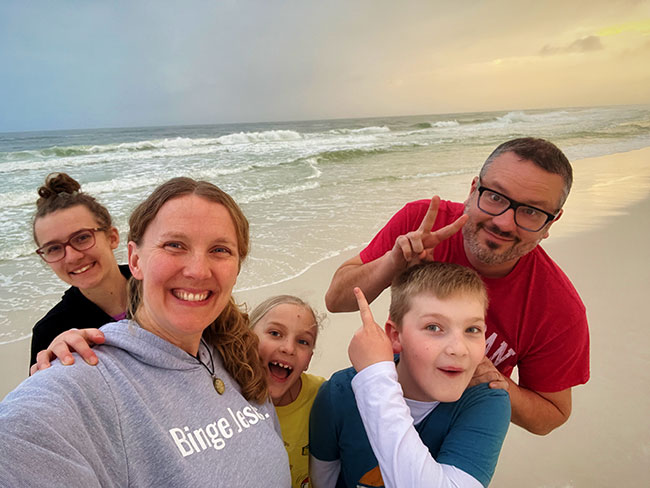
    Ok…that’s not exactly how it went when Kim and I decided our family needed a break and chose Destin as our destination. Spaghetti wasn’t involved; there were about two weeks between the decision and the departure, and we left our home pretty tidy.

    The first version of the story may be more dramatic, but we would have missed the best part.

    The anticipation.

    The anticipation of a positive experience is at least as valuable and enjoyable as the experience itself.

    Our January was dominated by the decline in health and the death of Kim’s father. It was an exhausting ride filled with uncertainty and big emotions. We originally planned to shelve our annual winter tradition of heading south for some sun, but after the month we’d had, we needed a reset. We needed to process the cyclone we’d just experienced. We needed to heal.

    And let me tell you, those two weeks of anticipation were just as valuable as the week we were actually gone.

    We made the decision before the wake and the funeral, so the upcoming trip served as a light at the end of the tunnel as we pushed through the home stretch of emotional turmoil and family obligations. Imagining the rhythmic waves of the ocean, the soft sand on our toes, and the chance to frolic in the heated outdoor pool fueled us and kept us moving forward, one day at a time.

    I’ve written before about how anticipation is the electricity of childhood, and a power source we adults don’t plug into nearly enough.

    Those two weeks of waiting cost exactly zero dollars, effectively making them free happiness. That’s what anticipation does. It makes you happy as you live good moments in advance, through your imagination. It fills you with a sense of hope and extra excitement, making it easier to navigate the valleys in your day-to-day.

    That’s the reason for my theory that you should always have a vacation on your calendar to look forward to.

    But I’m not alone in this thinking. “Imagining good things ahead of us makes us feel better in the current moment,” says Simon A. Rego, the chief psychologist at Montefiore Medical Center and Albert Einstein College of Medicine, who has written extensively on the effect of anticipation on mood. “It can increase motivation, optimism, and patience and decrease irritability.”

    Neuropsychologist Dr. Sanam Hafeez says, “Anticipation can be the key driving force in motivating yourself to get through life as you look forward to something that gives you a sense of optimism toward the future. If you’re having difficulty dealing with the past or present, anticipating what’s next can help get you through it.”

    “The suspense is terrible, I hope it will last.”

    –Willy Wonka

    As we drove back home after our week was over, grateful for the good memories and the chance to get away, we started imagining our next adventure. Kim and I spent several hours dreaming about the year ahead, filling our calendar with experiences to look forward to. 

    What about you? Is your next vacation already on the books?

    Of course, you don’t need a full-on vacation or a ton of money to take advantage of the power of anticipation.

    Our family Sabbath delivers that on a regular basis. As business owners and homeschoolers with three kids, our weeks are fuller than a house occupied by Bob Saget, John Stamos, and Dave Coulier. But we manage to carve out one day a week with nothing but whitespace. It keeps us going because we know there’s a place to land and fill our cups after all this activity.

    In addition, most weeks Kim and I have a date night, which serves as another little bright spot to look forward to, besides, you know, actually strengthening our marriage.

    Since moving to Sheboygan, we take off Fridays during the summer, designating them as “beach days.” After a few lazy hours spent on the edge of Lake Michigan, we return home, order pizza, and watch a movie. We all look forward to those days.

    What small things could you plug into your calendar that will give you something to look forward to? Perhaps a get-together with a friend you haven’t seen in a while. A surprise birthday party. A celebratory meal out. A day trip to a state park. Heck, our beloved Celebrate Everything calendar even gives you permission to make up your own holiday if you need to.

    Remember, anticipation is free happiness. 

    Want an easy way to keep Adultitis at bay?  

    Always have a vacation on your calendar and something to look forward to next week.
  • The Art of Letting Go

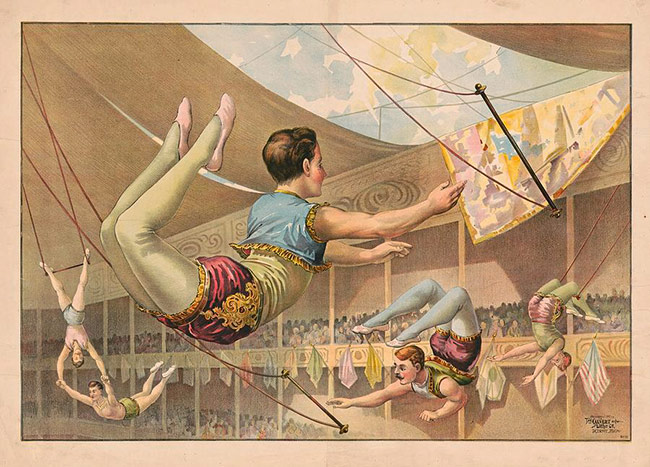
    He floats through the air with the greatest of ease
    The daring young man on the flying trapeze

    The greatest of ease, my foot.

    Before daring trapeze artists can float through the air, they have to master an important skill: letting go. It may look easy from the ground, but it’s anything but. 

    When it comes to flying from one trapeze to another, it turns out the letting go part is mandatory. It requires a leap of faith – in which, for a brief momen,t the person is not connected to anything or anyone – before they can move through their routine and delight the audience.

    In the circus known as Life, this is a skill we need to master as well.

    Over the past few months, I had a front-row seat to witnessing my father-in-law letting go. First, it was in the process of downsizing and moving to Sheboygan. It required saying goodbye to tools he’d no longer use and projects that would be left undone. Then, as he faced the prospect of his earthly life coming to a close, he went through the process of letting go of this life to embrace the next. It wasn’t with the greatest of ease, I assure you, but he handled it with grace and daring.

    Many of us will face this challenge at the end of our lives, but we all confront it throughout our lives as we transition from one season to another, from something safe to something uncertain.

    Graduation finds us leaving the comfort of school to enter the real world and our first job.

    Marriage finds us leaving the independence of singlehood to enter a shared life of sacrifice. 

    Retirement finds us leaving a predictable role and schedule for a wide-open calendar filled with unknowns.

    And sometimes we have to let go of a relationship or say goodbye to a sweet season in our life in order to fully enjoy the new season ahead.

    In my own journey, I occasionally experience feelings of resentment over the storm that ravaged our backyard last summer. I often feel angry that our woods are gone and that we’ve been saddled with an enormous bill that limits our freedom in other areas of our lives.

    But I have a choice. I can stew in my resentment and close myself off to what’s next, choosing to dwell on what was, even though there is nothing I can do to bring it back. Or, I can decide to reach for the next trapeze. And that requires a true letting go, a willingness to experience a brief time in which I am no longer attached to the past but not yet certain about what the future will hold.

    You can’t grab the gift that’s waiting for you if you’re still holding on to the empty box the last gift was in.

    Are you in a spot right now where you feel stuck, unsettled, or torn? 

    Maybe it’s time to let go of something so you can reach out and grab your next adventure.

    Don’t let the daring young man on the flying trapeze fool you. The process of letting go is scary, anxiety-inducing, and unsettling. 

    The art is in knowing that peace is found on the other side of your leap of faith.

  • When is Failure a Success?

    400 hours…almost.

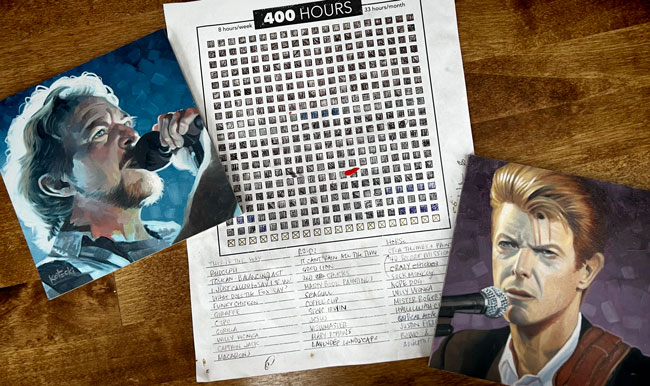
    At the beginning of 2022, I set a goal of achieving 400 studio hours. It was born out of a retreat I had a month earlier in which I felt God telling me to spend less time doing His job and more time doing mine. It was made clear to me that a big part of my job included making art. I figured an average of 8 hours a week was worthy of aiming for.

    After starting out of the gate strong, I hit a speed bump when we went on vacation to Florida at the end of January. Missing a whole week required me to squeeze in those eight hours elsewhere. It took me till the end of February to get caught up.

    Things went off the rails again in June, when a one-hundred-per-hour straight-line wind ripped through our backyard and upended our life for the next few months. In the meantime, we were busy preparing for our first out-of-state Escape Adulthood Summit, leading to another week out of the studio while in Utah.

    Despite the challenges, I kept chipping away, painting in the living room and at the kitchen table while my studio was being renovated. I was filling in boxes on my homemade chart, one by one, slowly but surely. 

    As we rolled into December, I could taste it. I was several weeks behind, but 400 was still doable. It would require some late nights and weekend effort, but it was possible.

    And then…I decided to let it go.

    It was not an easy decision, but something had to give. All three of our kids’ birthdays are between Thanksgiving and Christmas, and the addition of hosting a piano recital and the usual holiday preparations had me overwhelmed.

    The thought of giving up on 400 hours surfaced, but I didn’t want to give it any oxygen.

    Sure, the number itself was completely arbitrary. And yes, when I came up with it, I forgot to factor in simple things like taking vacations. In fact, I remember 380 hours feeling more realistic at the time, but it didn’t have the same ring to it as 400, so I went the route of an overachiever!

    All that said, I am no quitter. A lot of people knew I was working toward this goal. I didn’t want to publicly admit defeat, and I didn’t want to fall prey to the easy rationalizations we are so quick to conjure when we find the road harder than we expected.

    On the other hand, I was getting stressed out. I was worn down from a very difficult year. I wasn’t enjoying the family time because I saw it as a distraction from achieving my goal.

    Finally, I asked myself the most important question: Why?

    Why did I set this goal in the first place?

    The reason was simple: to make studio time a priority. To make sure I was making art. It’s my favorite thing to do, but easy to put off for more “urgent” things. (Pro tip: urgent things are rarely the most important things.)

    The thing is, it worked. I persisted amidst the distractions of the storm and the displacement of having no consistent place to work. I was prolific, creating more art than I’d made in years. But the hard truth was that somewhere along the line, I had made the goal a god. 

    The goal was no longer serving me; I was serving it.

    My intentions had become polluted. Achieving the goal was more about my pride. The process was poisoning my health, my relationships, and my love of art.

    And so, after much deliberation and prayer, I decided to forgo the final row on my scoreboard, crossing off the boxes in gold ink, designating them as an offering of sorts. 

    My pride took a hit, but my spirits lifted. It still required intentionality to reach 380, which I did on New Year’s Eve.

    So that’s it. That’s my confession, an admission of failure that I consider a success.

    Maybe there is a lesson here that is useful to you.

    I hope it’s not permission to give up too soon on something that matters to you, but perhaps an encouragement to give yourself grace, and peace to know it’s ok to pivot when plans change or you gain new information.

    More than anything else, it’s a reminder to keep that most valuable of questions –– why? –– at the ready. 

    Why did I set this goal?
    Why did I make this choice?
    Why did I start this thing in the first place?

    A question that starts with “why” is a great prescription for clarity.  

    And it helps keep us on the right track, making sure our goals serve us, not the other way around.

  • What Makes Someone an Artist?

    What makes an artist an artist?

    I was dubbed an artist as a kid, and I have held onto that label ever since. Back then, I operated under the assumption that artists were people who were good at drawing things. Eventually, I started to realize that artists came in many flavors. We could include painters, sculptors, fashion designers, photographers, poets, songwriters, musicians, actors, dancers…and the field grows. 

    Looking at the aforementioned list, one might be tempted to reframe an artist as anyone who does creative work. Which is fair. But doesn’t it require creativity to figure out a way to cure a rare form of cancer? Or to keep the doors open when the staff is short-handed? Or to feed a family of six on a shoestring budget?

    Now it’s getting tricky. 

    Perhaps, from a certain point of view, we are all artists, YOU included (yes, even if you’re not so hot at drawing things). If you are using your creativity to solve problems and make the world better – and by default, a little more beautiful – welcome aboard.

    Nailing down exactly WHO is an artist is a challenge. But I propose that an even more difficult task is believing you ARE one.

    My wife Kim is an artist, and she knows it. But it took her a long time to own it.

    I started noticing it some years ago when she began taking photos on her walks. She’d return with her heart full and a hop in her step, showing me the treasures she’d captured with her iPhone. They were interesting, different, and enthralling. “These are good!” I’d say, but my compliments fell on deaf ears for a very long time. Husbands are supposed to say nice things to their wives, after all.

    Her rebuttals were predictable: She wasn’t using a fancy camera. She had no training. She wasn’t doing it for money.

    Of course, some of the best artists were self-taught.

    The best tools have never been a requirement for making great art.

    Vincent Van Gogh – one of the greatest, most beloved artists of all time – only sold two paintings in his whole life.

    And I’m sorry, I don’t think you can look at these photos and NOT see art.

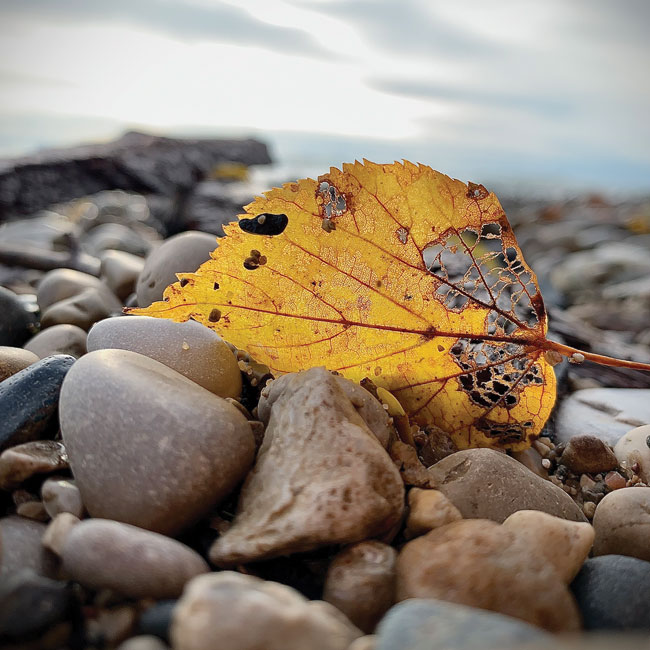
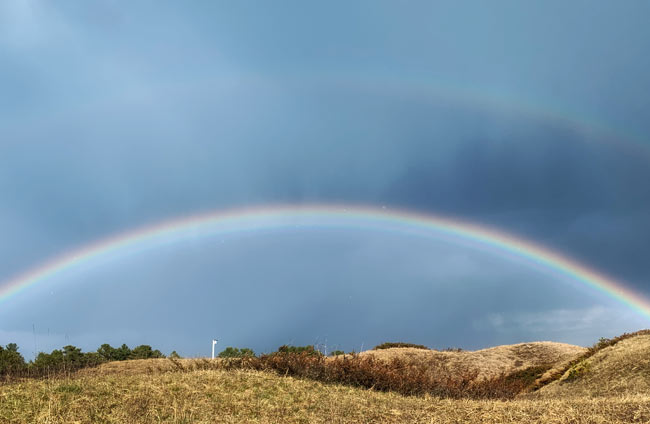
    Fortunately for all of us, Kim has come around to reality. She IS an artist. She notices things the rest of us don’t see and thankfully, uses her camera to capture the beauty for our benefit. While we impatiently wait for rainbows to show up on the horizon, she shows us wonder in a drop of dew, a heart-shaped hole in an old tree, and a delicate flower that maintains a fierce beauty even if it is a little past its prime.

    Meanwhile, she often uses words to knit those images together with deep truths that imbue us with inspiration, encouragement, gratitude, and hope.

    When we discussed the possibility of doing a book based on Kim’s photos, many people assumed it would be some sort of coffee table book: a glossy, straightforward collection of beautiful images. It could have been, and that would have been great. 

    But I’m happy to report it’s so much more. 

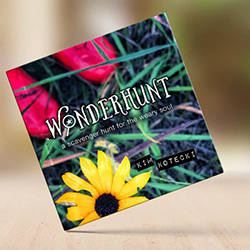
    Buy your copy of Wonderhunt

    In this gem, Kim shares the story behind her very first Wonderhunt, which came during a dark, lonely, overwhelming time in her life. It’s a story I know you can probably relate to, especially these days. She shares the amazing transformation that Wonderhunt ushered into her life, and gives you the tools to make Wonderhunt a life-giving part of your own. You’ll be drawn into a community of fellow Wonderhunters who are experiencing a magical brand of life together.

    There are exciting things on the horizon that I can’t wait to share with you,  and this book marks an important milestone and a new beginning. Our company, Escape Adulthood, is entering an exciting new era in which I am no longer the sole artist on the marquee. 

    And I, for one, couldn’t be happier.

    I am grateful to everyone who has purchased this book because your purchase proves what I’ve been saying all along: Kim’s point of view is unique, valuable, and something the world needs.

    Thanks to her, you will be awed. You’ll think. You’ll smile. You’ll laugh. You may even shed a tear or two. 

    Because that’s what the best art does.

  • Follow the Arrows

    In January of 2020, I was thisclose to giving up on my twenty-year dream of living in a lake home. Then the pandemic hit, making the decision all but irrelevant, considering the fact that I calculated that if we didn’t figure out an alternative revenue stream to speaking, we’d be bankrupt by November. Instead, that became the month we signed a contract to buy our dream house on Lake Michigan.

    How did we do that? 

    Well, my faith gives all the credit to God, who opened doors and led us every step of the way.

    All we did was follow arrows.

    The concept of following arrows comes from a book I read by Emily P. Freeman called The Next Right Thing. It was a metaphor that harmonized perfectly with the advice I’d been giving for years on tinkering.

    The premise is that sometimes in life, we’re looking for answers to our problems. But instead of answers, we get arrows. These arrows are the next steps on the journey.

    The problem is that we ignore the arrows, or even worse, let our logic get in the way and smother them with our own agenda. 

    Our job is NOT to wait for the entire plan to be revealed before we take our first step. 

    Our job is NOT to figure out five steps before we take the first. 

    Our job is to stop our frantic search for answers and follow the arrows instead.

    One. At. A. Time.

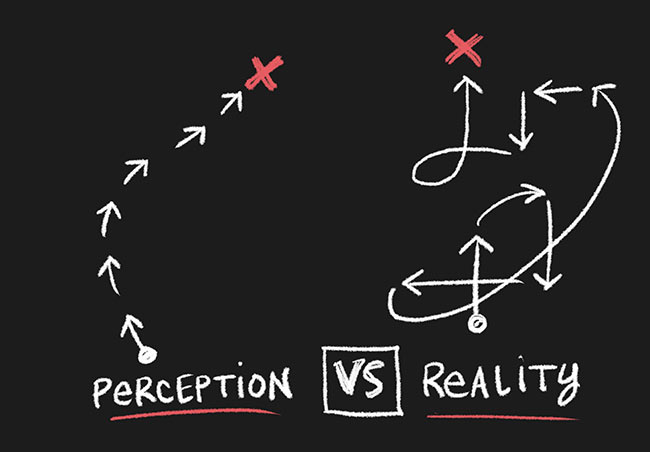
    In the process of sharing this concept with others, I’ve seen that some people misunderstand what this process looks like. They imagine an orderly progression of steps that make sense. Ha! It’s almost never like that, at least in my experience. It looks more like this:

    What “following the arrows” looks like.

    It’s haphazard and maddening, a path littered with false starts, dead ends, and wasted time.

    You usually can’t see more than one arrow at a time, and the steps are never as sexy or certain as we’d like them to be.

    I’ve told the story of how following arrows led us to our dream home in my short film, Here Comes the Sun. At one point in our journey, we followed an arrow that led us to visit wooded lots with intentions to build. We traipsed through brush and fields with our realtor, eventually realizing that building our dream home wasn’t the right option for us. It seemed like a dead end.

    But that assessment is what led us to the next arrow: visiting a Parade of Homes. There, we met a contractor, someone we had the feeling we were supposed to know.

    Eventually, our search led us to the perfect house, and we put in our best offer. We didn’t get it. Another dead end, or so it seemed.

    We kept following arrows, looking at other homes, and came upon one that seemed right, but was more expensive. It required us to get more creative with finances, and Kim’s parents offered to float us a loan. 

    We put in an offer. We didn’t get it. (What the heck, arrows?!) 

    A month later, out of nowhere, the original house came back on the market, and we were able to get it for a better price. The extra money from Kim’s parents became the seed money we needed to build out my art studio. 

    When it came to that point, we reached out to the contractor we met at the Parade of Homes to bid on the renovation. He took forever, and when we finally received it, it was way more expensive than we could afford. 

    That led us to consider another guy we hired to install light fixtures, who we later discovered also did contracting. Chad has been a Godsend, and the process of working together has connected us with many people who have helped our family in various ways. 

    This is just a snapshot of our story. I skipped a few arrows for the sake of brevity, but in reality, the formidable path stretched across two decades. It remains a good example of how the process of following arrows is rarely neat and orderly. It only looks that way in retrospect, because with the power of hindsight, we can see how it all worked together — all the twists and turns and dead ends — in a way that served a purpose.

    But in the middle of it, it’s a hot mess. It’s slow, then fast, then slow again, offering up a sharp left turn where you ram into what appears to be a brick wall. But it’s there another arrow is revealed, an arrow you never would have found had you not made it to the brick wall in the first place. 

    It requires humility to take what feels like a small, inconsequential step when you’re tempted to wait for a seemingly more significant, more productive one.

    It requires discipline to keep reminding yourself that you only have to look for and take the next arrow, not the next ten, or five, or two. 

    It requires courage to follow the clear arrow in front of you when the next one after that is nowhere to be seen. 

    It requires persistence to keep going when you are discouraged by the brick walls.

    And it requires faith that the path will eventually make sense, and that the twists and turns and detours all serve a purpose.

    Maybe you are in the middle of a dense forest right now, hemmed in by thorny thicket and brambles. Maybe you’re in the middle of a barren desert, with no answers in sight.

    It’s ok. Follow the arrows instead.

    God won’t let you miss your future.
  • Always Stop at the Lemonade Stand

    I grabbed my keys and slammed the door as hard as I could. 

    I got in the car and headed out of our neighborhood. I may or may not have screamed some choice obscenities as loud as I could, hoping it might exorcise the anger that was overflowing within me. 

    What drove me into this state of rage?

    Just the realization that I’d forgotten to buy one of the main ingredients for that evening’s dinner.

    A small thing in the grand scheme, and I am normally as mild-mannered as they come, but this tipping point was the latest in a long line of assaults from Adultitis. I’d had a terrible, horrible, no good, very bad week, and the missing box of jambalaya rice mix was the last straw.

    During my five-minute drive to the grocery store, trying hard to stew in my anger while maintaining a reasonable speed limit, I saw it.

    A lemonade stand. 

    Dammit. You’ve got to be kidding me. 

    So last summer, I established a new personal policy regarding lemonade stands. You see, I am a bit of an over-thinker. My old pattern of behavior went like this: I’d see some kids running a lemonade stand and think about stopping, only to drive past it while overthinking it to death. Did I have cash on me? Did I have the time? Was there even a convenient place to park? I’ve already driven six blocks past it; it would be stupid to turn around now. Ultimately, I’d miss the moment and feel bad for the rest of the day.

    Last year, I decided to take the thinking (and overthinking) out of it. I decided to establish a new rule: ALWAYS STOP AT THE LEMONADE STAND. Of course, for this new personal policy to work, it had to be ironclad. The only way to avoid overthinking was that there could be no exceptions. No excuses. I gave myself permission to be late wherever I’m going. Even if I was late to my own father’s funeral, “I had to stop at the lemonade stand.”

    The key to the whole thing is something I learned from Jack Canfield years ago, who said, “100% is a breeze, 99% is a b!tch.” The idea is that when it comes to any sort of goal, habit, or resolution you establish, it’s a lot easier if you don’t give yourself any outs. Commit 100%. If you allow yourself even one exception, then it’s always a fight from then on. You’ll always give yourself a reason why it’s ok to ignore the rule “this one time.”
     
    I liked this new policy. I liked that it allowed me to be more generous, and I liked that it was in line with the type of person I want to be. Since then, I’ve stopped at two lemonade stands. I always ask the kids what they’re raising money for. I always try to encourage them in some small way. And I always overtip.

    Even though I foresaw days when I’d encounter a lemonade stand when I was running late, I didn’t consider days when I was really, really angry.

    But a rule is a rule. No exceptions. No excuses. 

    Always stop at the lemonade stand.

    The two girls – they looked like sisters – were sitting on lawn chairs behind a folding table. They looked bored out of their minds until I pulled up and got out of the car. They were offering two options, regular lemonade and raspberry lemonade, which I told them was a good strategy. I ordered one of each, fifty cents a glass. I asked them what they were saving up for, and they sheepishly admitted, “Hopefully a pug.” I gave them a five-dollar bill, told them to keep the change, and wished them luck.

    There are a bunch of lessons here, and I trust you’ll find the reminder you need most right now. But as I returned to my car, with two plastic cups of lukewarm lemonade in hand, I realized something.

    I was no longer angry.

  • Based on True Events

    Sometimes you’ll see a message at the beginning of a movie letting you know it was “based on true events.” There’s something dramatic about it because it’s exhilarating to watch an amazing story that wasn’t just imagined, but really happened.

    At least part of it.

    You see, I’m always skeptical of that claim because I feel they’re being intentionally vague. It makes me wonder, what parts are the true parts? How much of it is factual? Half? Thirty-three percent? One percent?

    Did they leave out important details? Or exaggerate stuff for the sake of a better story? Did they shorten the timeline and turn the long, hard slog into a snappy, inspiring montage with an Ed Sheeran song playing underneath?

    After the movie is over, a quick review of Wikipedia often reveals a different story than the one that makes a good motion picture. Like a good fishing story, certain parts may have been embellished for dramatic effect.

    Sometimes we try and fashion our own lives based on true events. And that can be a trap.

    Yes, that musician we admire got a record deal and is now touring the country to sold-out arenas. But we didn’t see the seven years she spent sleeping in her car and couch surfing at friends’ places while she toured the state, playing to crowds of tens.

    If we see someone who is successful and try to model our lives after theirs, doesn’t that make our lives based on true events? Because indeed, we never see the full story. Maybe we only get half of it. Maybe we only get one percent.

    We don’t see the sacrifices put in. The long nights crying into a pillow. The demons they had to fight through. We don’t see the boring parts where nothing seems to be happening, and a breakthrough feels like it’ll never come.

    That’s my story. I had many role models as I pursued my dream, all of whom seemed to achieve their dreams way more easily, quickly, and dramatically than I did. Kim and I spent nearly a decade living in a crappy apartment, drowning in debt, doing everything we could to keep our hope from blowing out, and wondering what we were doing wrong.

    Good times.

    Now we live in a beautiful house overlooking Lake Michigan and make a living doing what I love. People who are entering my story now – especially the new people we’ve encountered since moving to Sheboygan eighteen months ago – don’t see the whole picture. I’m sure many just see one big “must be nice,” oblivious to the twenty years it took to get here.

    By all means, take inspiration where you can get it, but never forget the inspiring stories you are privy to are based on true events. 

    Don’t be discouraged if your story feels more difficult than your hero’s, or is taking longer than you think it should to get to the happy ending. Keep going through the hard slog. Keep taking it one day at a time. The best dreams take a while and are achieved in the moments never seen by the camera.

    And remember that when they make a movie of your life, they’ll probably gloss over this part with an upbeat Ed Sheeran song.

  • Is Life Giving You a Better Offer?

    My mind whirred to life, like a computer booting up from sleep. I was awake, but my eyes remained closed. After a momentary delay, my ears tuned in to the hushed symphony of rainfall. Not a storm, not a weak drizzle, but the sustained sound of polite applause.
     
    Bliss.

    My mind turned its focus to the day ahead. My Monday morning to-do list was waiting, and my brain divided against itself. “It’s important to start the week off strong. If you give in at the start, the rest of your plans have no chance,” said one side.

    The other half calmly responded, “Mornings like these don’t come along very often. You may not get another one for a very long time.”

    I opened one eye and located my phone, carefully unlocking it long enough to turn off the alarm. I rolled over, put my arm across my wife, and savored some extra time being serenaded by Mother Nature.

    This might sound like the justification of a procrastinator. I assure you I am not one of them, at least when it comes to work. I tend to err on the other side, too busy working to smell the roses, or in this case, listen to the morning rainfall.

    I owe much of my success to my work ethic, my planning, and my to-do lists. But once in a while, we have to be willing to scrap our original plans and surf the wave of spontaneity. Sometimes life gives you a better offer, and I’m learning there is wisdom in not being so quick to turn those offers down.

    On this day, at this moment, I was allowed to enjoy life, not simply race through it as if it were an obstacle course of never-ending to-do lists. I took it. 

    Science tells us that humans are more afraid of losing something we already have than we value gaining something we want. Sometimes, the thing we are most afraid of losing is our imagined idea of how we expected our life to go. 

    In different seasons of my life, I’ve wanted to get paid to paint portraits of athletes, illustrate movie posters, and become a nationally syndicated cartoonist. I also expected I’d marry a brunette. 

    Am I a failure because these plans didn’t pan out? No, I released those dreams because in each case, life ended up giving me a better offer.

    “One of the secrets to a successful life is to recognize a better offer when we get one and be open to receiving it and reveling in it…instead of sticking to a formerly prescribed plan.”

    –Sam Horn

    I loved our backyard, a magical woodland stationed with pine sentinels. As I write this, excavators are ripping most of them away after a terrible storm pushed them over like a giant-sized game of pick-up sticks. It’s hard to see anything good coming from it, but if I squint carefully, in my mind’s eye, I can make out a backyard that’s even more magical, one that will give birth to even better memories. 

    Life rarely goes as planned, and that can be painful sometimes. It’s easy to find ourselves holding on to an idealized vision of a long-hoped-for future. But those clenched fists prevent us from being able to receive what’s next.

    Life might be giving you a better offer.

  • Why “Ugly or Beautiful?” is a Trick Question

    One day Kim wrote a social media post about how ugly our backyard is after having been ravaged by a cataclysmic storm. The harsh, violent, apocalyptic hellscape is heartbreaking.

    And very, very ugly. 

    A well-intentioned commenter felt the need to correct her, “No, it’s beautiful.”

    Of course, the commenter is right. It is beautiful, in many real and metaphorical ways. And the photos Kim has taken of the carnage have captured some of that beauty.

    But you know what? It’s also ugly. Especially in comparison to what it was before.

    It can be both. It is both. And that’s ok.

    As I pointed out in my book, A Chance of Awesome, some people look at dandelions and see weeds. 

    Others – mostly kids – see wishes.

    The thing is, both are true. 

    Or take cars. Automobiles are modern marvels that give us great freedom and save us enormous amounts of time. The industry employs nearly two million people. But about 40,000 people die in motor vehicle traffic crashes each year in the U.S.

    So are cars good or bad?

    Unfortunately, our rotten news media has conditioned us to operate without any nuance whatsoever because there is profit to be made in conflict. We no longer seem to have the capacity for critical thinking; we’ve been reduced to the infantile reflex that things are either “good” or “bad.” Every issue is presented as either black or white, red state or blue state, right or wrong, good or evil.

    Ugly or beautiful.

    When it comes to any story – especially the headline-grabbing issues of the day – we’ve been duped into believing we only have two options: be right or be wrong.  

    But life is more complicated than that. Life is both / and.

    When your kid heads off to college for the first time, it’s natural to feel a sense of pride as they move into a new season of growth and independence. It’s also natural to feel sad that your day-to-day interactions with them are coming to an end. 

    Or when a loved one you have taken care of for years has passed away, you probably feel sad that they are gone. It can also feel nice to believe that they are in a better place. 

    But you can also feel relieved that your burden has been lifted. 

    That doesn’t make you a monster; it makes you human. 

    We live in a complicated world with unlimited shades of grey. (Yes, even more than fifty.) It’s not helpful to force everything into an absolute. We don’t have to walk around wearing rose-colored glasses, deluding ourselves into thinking everything is unicorns and rainbows.

    Nor is it especially healthy to point out every potential storm cloud. 

    Both approaches are childish. 

    A mature perspective is acknowledging that life is filled with contradictions. There is good and evil, joy and pain, hope and fear intermingling in all of it. 

    We do have a choice about where we want our attention to dwell, which is one of our most overlooked and underused superpowers. But it’s important to remember that focusing on one doesn’t disappear the other. 

    Life is painful. It is also joyful. Sometimes on the very same day. 

    And that’s ok.

    Acknowledging the ugliness is what keeps us from taking beauty for granted.
  • How to Help Someone Who Is Grieving

    My young traveling companion poked me on the elbow with a request I didn’t see coming.

    From the moment Kim and I made the decision to move ahead with taking Ginny on her first Daddy-Daughter trip despite the storm that had wrought havoc on our home, my mind was in overdrive. 

    From forcing it to focus on what needed to land in my suitcase, to finding a gas station that had power so we could refuel, to asking the gate agent if he could make sure our seats were together, my brain was busy anticipating and solving every challenge that presented itself on our journey to Tennessee.

    Finally, we were on the plane, seats together, and her seatbelt was buckled. (Good thing they still have those important safety messages; the break from traveling left me rusty on knowing how seatbelts work.) Everything was going smoothly. Our first leg was almost over as we started our descent into Detroit. 

    Then came the gentle poke and the unexpected request.

    “Can I hold your hand?”

    She didn’t need to say anything else. The look of concern – but not panic – in her sparkling blue eyes said enough. It wasn’t her first flight, but it was the first in a while. And the landing part was giving her pause.

    “Of course,” I said as I grabbed her hand. 

    No other words were exchanged, but during the descent, every time her stomach sensed a sudden drop in elevation, she squeezed a little bit tighter. It made my Daddy’s heart swell.

    In the aftermath of dealing with the losses dealt by the storm, it’s been interesting to be on the receiving end of people trying to help us as we grieve. As far as I can tell, everyone is well-intentioned. But their level of effectiveness…varies widely.

    The truth is, helping someone who is grieving is incredibly hard. Especially when it comes to knowing what to say. We want to provide comfort, we want to take away the pain, we want to say the right thing.

    It’s hard. But Ginny helped me to see that maybe we make it harder than it needs to be. 

    When she meekly reached for my hand, she just needed me to grab it.

    She didn’t need me to tell her her feelings were wrong. 

    She didn’t need me to explain the physics of aerodynamics and how we were perfectly safe.

    She didn’t need me to remind her that other people are dealing with even scarier things. 

    She didn’t even need me to tell her it was going to be ok. 

    She didn’t need me to say anything. 

    She just needed me to hold her hand. 

    She just needed me to be there.

    On a day that had me feeling overwhelmed, overmatched, and out of my element, it was the one thing for which I was totally qualified.

    Maybe you’ve been given the opportunity to come alongside someone who is grieving. Maybe you will be soon. 

    It’s not an easy task, but you are plenty qualified for it. Don’t worry so much about what to say. They don’t need you to tell them their feelings are wrong, or how things could be worse, or about someone you know who went through something even harder, or even that everything will be ok. 

    It might be better if you don’t say anything at all. 

    Just metaphorically (or literally) figure out a way to hold their hand or give them a really big hug.

    It doesn’t seem like much, but trust me, just being there matters.