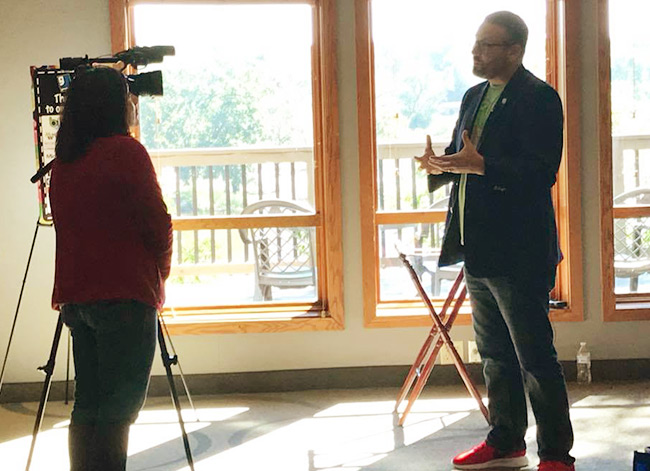
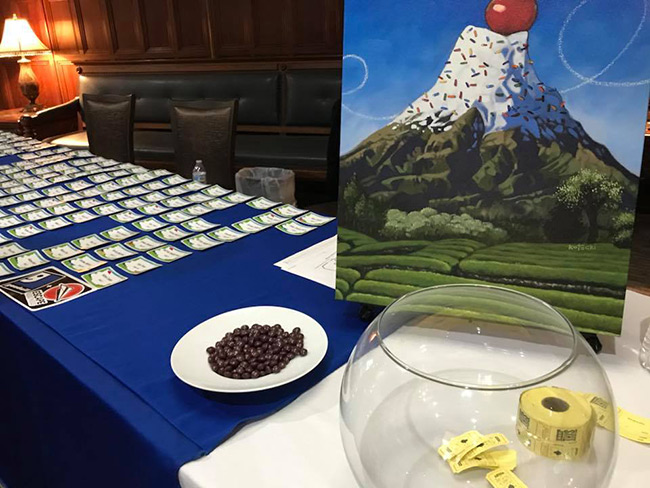
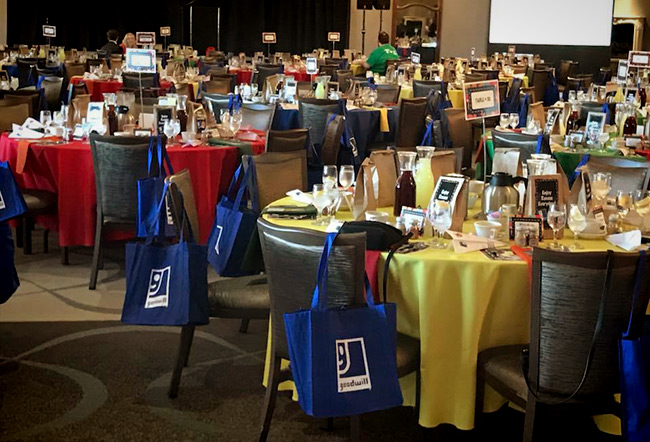
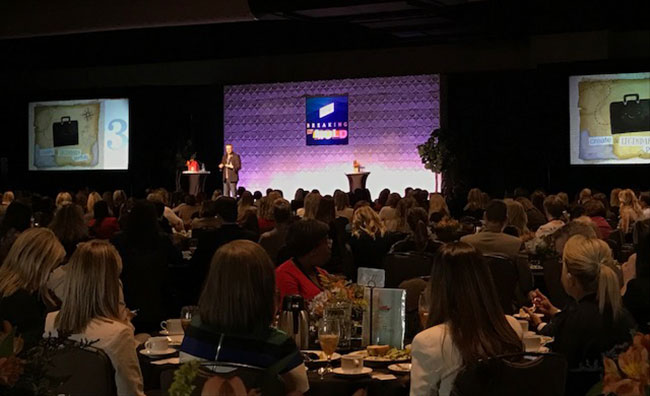
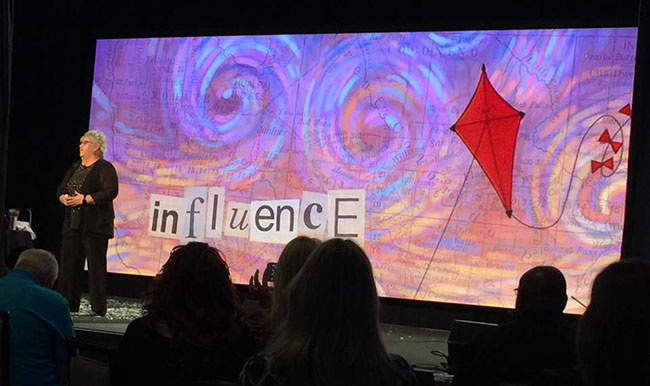
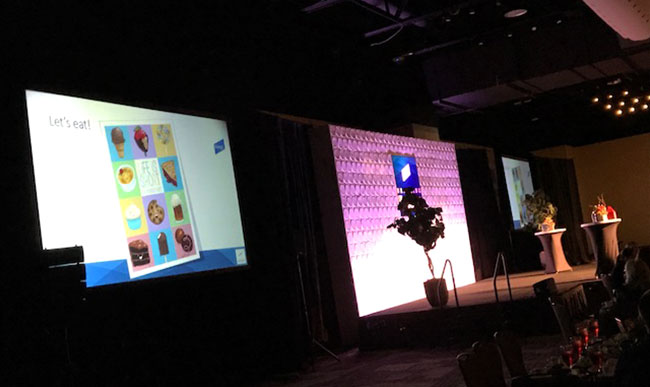
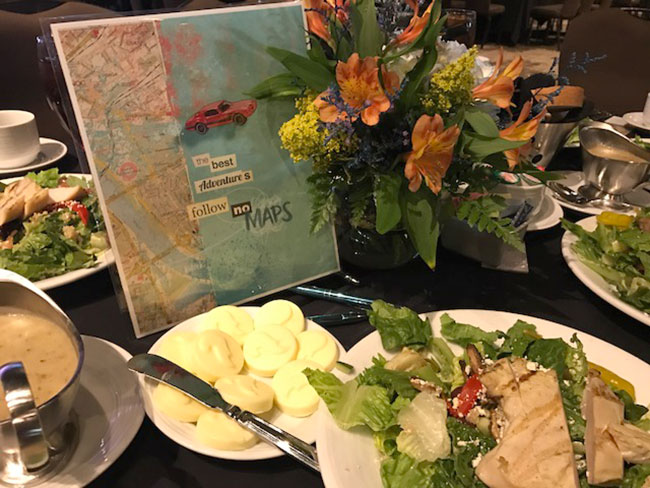
We were thrilled to help Goodwill with a fundraising event they dubbed “Escape Adulthood Recess.” Designed to be a break from the workday, we worked with the fabulous folks at Hayes Marketing Services and the Goodwill Northern Illinois team to create a successful networking luncheon that raised a lot of money and created a lot of positive buzz.
The careful attention to detail helped create a fun and approachable ambiance and tied the theme together wonderfully. Here are some photos we managed to snap to give you some food for thought for planning your own event.
After months of anticipation about our family’s first trip to Mexico and an escape from the Wisconsin winter, the weather report turned foreboding. All eight days were calling for rain. Kim and I were crushed. Our family had finally recovered from a three-week battle with the flu over the holidays, and we were looking forward to the time away to recharge in the sun and surf. Kim was especially fretful about the forecast of rain, incessantly checking the weather app on her phone.
On the plane, I read a section in a devotional about God being a “living God.” That struck me. I grew up thinking of God as some far-off historical figure who did a lot of neat things in olden times, forgetting that He lives in the present tense, active in the here and now.
In that moment, I felt totally at peace. Did I expect God to alter a weather system on account of li’l old us? To be honest, I guess I hoped He would, but more than that, I knew that the only way to really ruin the vacation was to spend all our time worried and anxious over the weather report. Even if it rained the whole trip, we would still have an opportunity to be together and to rest, away from the hustle and bustle of our daily lives.
We did pray for sunshine, but we also prayed for peace to melt away our fears, and for the perspective to make the best of whatever each day would bring.
No one knows with certainty what next year, next week, or even what tomorrow will bring. (Not me, not you, and certainly not weather forecasters!) But too often in life, we allow doubt and anxiety to dominate our perspective, and we live out our fears in advance. I knew that God knew how big of a deal this trip was to us, and He would give us what we needed from it, even if it didn’t look exactly how we imagined it.
So here’s what happened. Every single evening, the weather app on our phones indicated storms for the next day. And every single day, we woke up to sunny skies, while the thundercloud icon had vanished. The only rain we experienced was about a half-hour’s worth on our last day, and it came as a welcome relief during a hot walk at the Tulum ruins.
The abundant sunshine became a symbol to us of God’s goodness. As the trip was coming to an end, we searched for a sunshine-themed souvenir to bring home with us, something to remind ourselves of what felt like a mini-miracle and God’s active presence in our lives. We never did find anything just right.
We arrived home at about midnight. Our youngest child was asleep as we pulled into our driveway. A few police officers were canvassing the street with flashlights, clearly looking for something. We didn’t think much of it, figuring the neighbor kid was in trouble again.
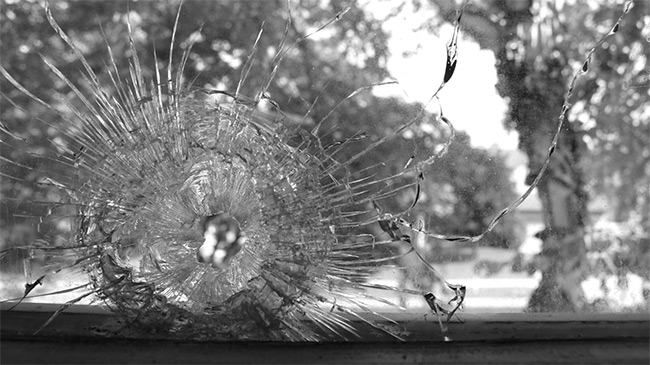
As our tired bodies, carrying overfilled suitcases, stumbled into the house, our oldest daughter said, “Hey, what’s that on the ceiling?” I looked up and saw a gash in the drywall. The directional groove led my eye to the window, which had a bullet hole in it.
A bullet hole.
“Kim,” I said, “Hurry and go tell the cops that we have a bullet hole in our window!”
The rest of the evening was a blur. We found small bits of glass all over the carpet and on the piano across the room. The officers pulled a bullet fragment from the ceiling, but it was too mangled to be of any use. They had very little information for us, except for the reports from neighbors, who had heard multiple gunshots and a speeding car with a bad muffler. At first, I was annoyed that I had to postpone the date with my bed to deal with this after having had an awesome vacation, but eventually, it hit me. “Wait. What if we had been home? This could have hit one of my kids.”
The mood quickly turned from annoyance to anger and fear.
None of us got much sleep that night. (Except Ginny, who was already asleep and would ask about that taped-up cardboard patch on our window two whole days later.)
The next morning, our six-year-old son, Ben, brought a bullet to Kim that he found in the hallway. “Momma, what’s this?” he asked.
Another call to the police.
The next few weeks were a blur of logistics and emotion. Assurances from the police that our neighborhood was historically among the safest in the city didn’t seem to help. Calls to the insurance company and various vendors about replacing the window and fixing the damaged ceiling were interspersed with the feeling of being violated and wondering if we were still in danger. I’d never seen my wife cry so much in all of our eighteen years of marriage.
We heard stories from neighbors who’d been home. Three young girls next door were in the front room watching TV when the shooting happened. An elderly neighbor across the street told us the gunshots were so loud that she thought her house was the one under attack. A young mother in the home next to hers was nursing her two-month-old in her front room. She hit the deck when the shots rang out. Everyone was shaken. For days, we saw cars slow down in front of our house to gawk at the scene of the crime.
Eventually, amidst the haze of fear and confusion, we began to notice where God had been working in the situation.
We realized that our house was the only one on the whole block that was empty when the shooting occurred. We figured out that it wouldn’t have been had we not been held up in Minneapolis so our plane could be de-iced. We felt His presence in the neighborhood meeting that was organized two days after the incident. Over fifty people crammed into a basement owned by a former police officer, bonding together to comfort one another and talk about practical ways to protect our neighborhood. It was neat to see connections get made and friendships deepen.
Finally, Kim and I got to a place where we could ask, “What does this terrible event make possible?”
Years earlier, we had stayed in a vacation home in Santa Barbara that featured some stained-glass windows. We’d always been smitten by their charm, so we wondered if we could replace the broken front window in our living room with a stained-glass work of art. The fact that the window in question was a decorative half-circle above the normal windows made it a perfect candidate. Maybe I could even design it. And maybe it would give hope to the rest of the neighborhood. We knew immediately what the design had to be.
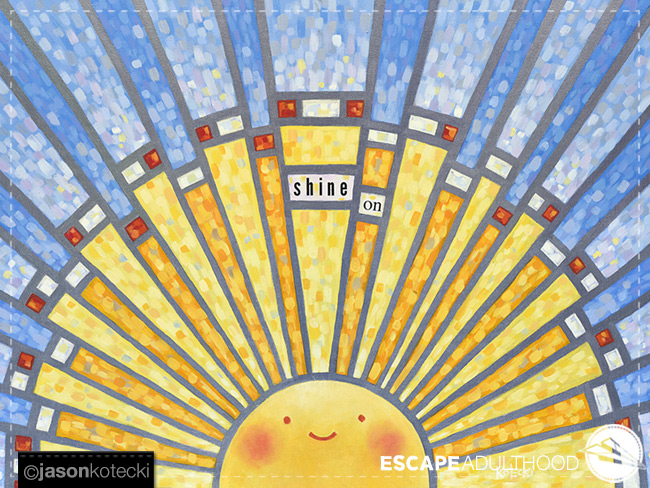
A sun.
We got connected with Rick Findora, who just so happened to be the guy who did the stained glass windows at our church, and I gave him a sketch.
We got our sunshine souvenir after all—after we returned home and in a form we never anticipated. It now serves as a beacon of hope to the entire neighborhood.
We live in a dark world, where tragedy and pain are all too common. Sometimes vacations do get rained out. Sometimes bullets don’t miss. But I believe this: God is a living God. He gives us small signs—signs that don’t seem like much in the grand scheme of things—just to let us know He is there. I think the reason He does this is so that when the bad things happen, we’ll remember that He is still there, ready to bring good things out of terrible circumstances. He gives us the sunny days to recharge us, to fill our reserves with hope that lights the way during the dark times, reminding us that the sun will shine again.
It’s worth remembering that even on the darkest, cloudiest days, the sun doesn’t disappear. It’s still there; it’s just hidden. The people who see silver linings are the ones who look for them. If you are in a dark season right now, keep looking for the light. It’s coming.
Finally, I believe we are called to be a light for others. We do this by sharing our gifts and by being kind. When it comes to people who disagree with us, instead of calling them names, we can call them up for coffee. The smallest things can make the biggest difference. Our happiness increases when we help others, shining our own lights outward.
In the battle between light and darkness, the darkness doesn’t stand a chance.
It’s a common question we ask children. Comedian Paula Poundstone says it’s because we’re looking for ideas.
The key word in that question is “be.” Too often, we adults change that word to “do.” It’s the classic, tried and true opening line you’ll hear at every bar, party, and networking event: So, what do you do?
That one little word changes everything.
When we ask kids what they want to be, they respond with an answer that sounds a lot like what they want to do. But if you pay attention, that’s not the case at all. Sure, they might say “firefighter,” “astronaut,” or” ninja,” but what they want to be is brave, adventurous, helpful, and a person who spends time doing what they love.
We’ve lost the plot, and in so doing, have lost our spark.
Spoiler alert: We are human beings, not human doings.
What if we’re currently in between jobs, or trying to transition from new season to the next? Does that mean we are nothing? If you’ve ever been in that situation, you know that’s often what it feels like. Meanwhile, waiting tables or cleaning bathrooms might be what we do, but that doesn’t fully represent who we are.
There is a lie that by the time you reach adulthood, you should have everything figured out. You have become who you are meant to be. And if you haven’t, it’s too late.
False.
We are all in the process of becoming something better. Always.
Judging by how college visits seem to be happening earlier and earlier in a high schooler’s career, the pressure for kids to figure out what they want to DO for the rest of their life continues to escalate.
As homeschooling parents, Kim and I have come to the conclusion that the being is more important than the doing. We asked the question, “When our kids are adults and out on their own, what do we want them to BE?”
For starters, we want them to BE… …kind. …confident. …curious. …resourceful. …honest. …passionate. …brave. …helpful. …adventurous.
If our kids end up being all of these things, I’m pretty sure they won’t have much trouble figuring out a way to do anything they want.
Yet here’s the thing. I want to be all of those things myself. Some days I am, other days I need a little work.
No one has it all figured out. We are always in a state of becoming.
So, what do you want to be when you grow up? Yes, I realize that you are already considered to be “grown up.” But what do you want to be when you turn 40? Or 50? Or 70? Or…100?
Perhaps you’d like to be more physically fit? Financially secure? Resilient? Handy? Forgiving? Adventurous? Brave? Kind? A more loving friend, parent, or spouse?
Whatever it is, good. Begin today. Be a little bit more of that than you were yesterday.
Figuring out what to do is simple.
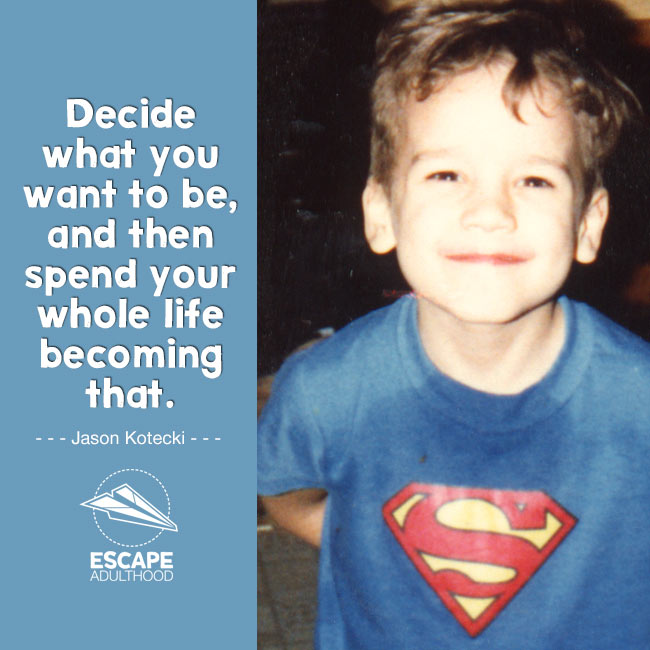
First, decide what you want to be, and then spend your whole life becoming that.
Recently, I was conducting a day-long workshop in Vancouver for a group of business owners. I was encouraging them to get intentional about what they wanted out of life. I’m surprised at how often this step gets neglected. It’s important because until we are clear on what we’re aiming for, we’ll end up aimlessly drifting along with the current, mindlessly following rules that don’t exist, while wasting time and energy making choices that don’t serve us well.
One attendee asked, “But what if we don’t know what we want?”
I don’t remember what I said in the moment, but I have thought about that question ever since. I’m not sure that “not knowing what we want” is a thing.
I think we’re just too afraid of picking “wrong.”
Most of us come from a school system in which we are taught that there are right answers and wrong ones. Everything we do is verified and validated by someone else. Of course, math and spelling and historical dates are binary: Right or wrong. But in school, even the subjective things are validated. Exactly how good is this poem? Was this book report sufficiently insightful? What grade does this clay pot deserve?
As you move through the system, one gets savvy at playing the game. To get good grades, you figure out which teachers really want you to read the book, and which ones care more about you taking good notes. You discover that some teachers will give you a good grade if you contribute in class once in a while.
After 18 years of this, these habits get pretty well-established. But this strategy that works in school becomes problematic in real life. Because now you’re on the hook. After graduation, the consequences are your own. The choices you now have to make don’t come with the certainty of a red letter on the top of a term paper.
It’s up to you to decide what an A+ life looks like.
I believe that in our hearts, we do know what we want out of life. It’s just that it’s too scary to own it without the validation that we made the right choice, or we become paralyzed looking for the assurance that the road we’re taking will work out.
The truth is that there are many right choices. Unfortunately, none of them come with any guarantees.
In lieu of the certainty of validation, most people calculate the risks and opt for the path that seems the safest. As we learned from multiple choice questions that stump us, it’s best to choose the one that “makes the most sense.”
Unfortunately, the safe path usually does appear to “work out.” But the further down that path we go, the more Adultitis settles in, our joy fades, and uneasiness grows within us, along with the sinking suspicion that we chose wrong.
The safe way is always easier. The heart way is always harder, more dangerous, and likely to fail.
To me, the choice is obvious.
The safe way always ends up with the same haunting question: what if?
You know what you want. You may not know all the steps to get there, but I’m confident you can figure out the next one.
Stop waiting for someone to give you permission to start.
If you’ve been following along for a while here, you know that I am a big proponent of breaking rules (particularly the ones that don’t exist.) What might surprise you is that I am equally cool with creating them, too, as long as you’re clear on the reason.
I want to share with you one of the most liberating concepts I’ve come across, and believe it or not, it involves making and abiding by strict rules.
It’s the idea of creating personal policies.
You’re well aware of how big companies devise all kinds of policies to protect their interests. You’ve heard it dozens of times: “I’m sorry ma’am, that’s not our policy,” or “Sorry sir, our policy clearly states…” As frustrating and ridiculous as some of these policies can be, you know that there’s not much you can do about them. They’re usually written by lawyers and backed up by loads of bureaucracy.
If you’ve ever arrived at your departure gate at the airport fifteen seconds after they’ve closed the door, you know their policy of not re-opening it for any reason is iron clad. You’re not getting on that airplane.
The cool thing is that we can dream up our own personal policies, and just like with the big companies, the people in our life will accept them (even if they don’t understand or like them.)
For instance, we recently instituted a personal policy for family vacations. Due to the nature of our business, we know a lot of people scattered all over the country. Anytime they hear that we’re in their neck of the woods, they want to get together with us. Which is flattering and much-appreciated, except that if we always said yes, we’d never actually spend any family time on our family vacation! So now, when someone asks to get together, we share that our personal policy is that when we take a family vacation, the time is reserved just for family.
This accomplishes several things:
It prevents us from having to choose which requests we could reasonably handle, keeping us from having to disappoint someone.
It gives us a gracious way to say no.
Most importantly, it keeps our schedule clear for the reason we’re taking the trip in the first place.
Keep in mind that we are a family of introverts. Other families might want to spend a lot of time meeting up with people they don’t see very often. I know some speakers who always try to find a colleague to have coffee with at every city they visit. That’s cool, too. That’s why they’re called personal policies.
The beauty of this approach is that just like with big companies, people don’t usually squabble with policy. It’s a policy after all, and people tend to respect them.
I originally heard about this idea from Sarah von Bargen of Yes and Yes, and I just loved it. Some of my favorite examples she gave that you might want to borrow:
I have a personal policy of never loaning money to friends.
I have a personal policy against riding with a driver who’s had more than two drinks.
I have a personal policy to buy Combos on any car ride that’s longer than 2 hours.
I have a personal policy that I buy gumballs anytime I encounter a gumball machine and have the requisite quarter.
As you can see, your personal policies can fall anywhere on the spectrum from fun to serious.
Sarah points out that establishing personal policies minimizes feelings of guilt, creates certainty by removing wiggle room we may not want or need, and that people tend to respect policies more than preferences or requests.
Kim and I have been doing this for years with our adherence to a Sabbath. Once a week, we set aside one day that is free from chores, errands, or outside commitments of any kind. It’s been non-negotiable and I credit it as the single greatest contributor to the health and sanity of our family.
The new wrinkle is referring to it as a personal policy, which for reasons outlined above, takes things to a whole new level.
Rules aren’t inherently bad. They can create structure out of chaos, and they can free our brains up to focus on more important things. The best ones serve us by creating more freedom rather than taking it away.
So consider this permission to go ahead and start adding more rules to your life. After all, if you’re going to follow rules, they might as well be your own.
Ever have one of those vacations that, when it was over, you said, “I need another vacation!”?
Sometimes we spend all our time lounging around and feel disappointed that we didn’t see more. But more often, we rush around trying to see and do everything, and wind up returning to work depleted, wishing for a redo.
You’ve taken time off work. You’ve probably invested no small amount of money. Don’t be the reason your vacation fails. It almost just happened to us.
Last summer, we got passports for all the kids so we could take a road trip to Canada. Kim and I asked our favorite question, “Now that we have this (passports for the whole family), what does it make possible?” We thought a foray into Mexico was a great next step to stretch our family’s travel comfort zone, before moving on to other places on our bucket list, like London, Australia, and South Africa.
The way I see it, vacations can fall anywhere on a spectrum with “Adventure” at one end and “Relaxation” at the other. A trip to Disney World, or a cross-country road trip, would be on the “Adventure” side, while lying on a beach or lake fishing for a week would be an example of the “Relaxation” side.
The key to making sure you don’t come out of your vacation disappointed is being mindful of what you want your vacation to be.
It sounds obvious, but it’s not always easy.
Our two-week road trip last summer included stops in Cleveland, Niagara Falls, Boston, Montreal, Ottawa, and Toronto. It was an “Adventure” trip for us. We didn’t run ourselves ragged, but we knew going in that it was more about seeing a lot of new places than it was about chilling out. Earlier in the year, we rented a condo near Clearwater, Florida. That was our “Relaxation” trip. Lots of sun, sand, and doing a whole lotta nothing. Both were great, because we were mindful of our intentions for each trip.
Mexico presented a problem because we hadn’t been as mindful going into it. Here we were in a new place, surrounded by so many new sights to see and attractions to visit. We knew we wanted to stretch our comfort zone and experience the culture. We felt obligated to see and do as much as we could, knowing this might be our only chance to see this part of the world. Meanwhile, our condo was on the beach, literally steps from the Caribbean Sea. We had just come off an especially busy year, recovering from a virus that put our whole family down for three weeks over the holidays. Our souls needed to be pampered with the aforementioned “whole lotta doing nothing.”
Fortunately, our first night after settling into the condo and putting the kids to bed, Kim and I had a conversation on the balcony about what kind of vacation this needed to be. Ultimately, we decided it should fall a few notches to the left of the “Relaxation” side.
Here are a few tips to help you avoid turning your next vacation into a hot pile of bad:
1) Remember that it’s impossible to do it all. One of Adultitis’s best tricks for ruining a good vacation is convincing you that you can actually do and see everything. This futile pursuit is a sure ticket to burnout. We decided to be ok with picking out a limited number of attractions we wanted to hit, knowing that we’d be missing out on a lot.
2) Give yourself permission to call an audible. Once you’re on the ground and reality looks a little different than what you envisioned, it’s ok to change things up, because now you have new information. We didn’t realize just how incredibly close our condo would be to the ocean. It was like a dream! With such an amazing location, we realized how silly it would be to spend most of our time leaving it to do something else.
3) Listen to your soul. As I mentioned, we had a bit of a rough landing at the end of 2017, and really just needed some time to recharge. The thought of spending most days shuttling from tourist attraction to tourist attraction made our souls throw up in their mouths a little. So we honored that and were rewarded with full hearts and peaceful spirits.
4) Examine the “rules that don’t exist” you’ve written in your own head and challenge them. In our case, “Thou shalt not eat at the same restaurant more than once, and definitely not more than twice” went down in flames. There was a cool beachfront cafe a short walk from our condo that had amazing views, great food, and frosty tropical drinks. You could literally have your feet in the sand as you dined. As it was the type of place we would have wished we could find somewhere on vacation, we decided it was dumb not to frequent it regularly simply because of some stupid #notarule. So we ate there nine times.
In the end, we enjoyed one of our best vacations ever. I’m so glad Kim and I had that conversation on the balcony, or we might have ruined our trip.
Keep in mind, had we not gotten sick, or our year had gone a little differently, or we had stayed at a different condo a mile away, or if our kids were a little older or younger, the trip would have been completely different. And that could have been a perfect trip too, as long as we were mindful about what kind of vacation we needed.
Just like in the rest of our lives, the magic is in the mindfulness. Don’t throw away your chance at a perfect vacation doing the things you feel like you “should” do. Having lots of choices is good. But not if they make you feel like you have to say yes to all of them.
The only thing you should do is spend some time thinking about what would make it perfect for YOU.
The world is changing at an ever-increasing pace. Meanwhile, most of us are being asked to do more with less. The answer to a prosperous and glorious future, it seems, is innovation. That’s all well and good, except for the fact that innovation is often regarded as one step away from sorcery. It is reserved for the super smart, super creative, or super inhabitants of Silicon Valley.
Hogwash.
You can be more innovative, right now, today. (I don’t care if you are reading this in your pajamas or your hair looks like it just took on a tornado.)
The dictionary tells us that innovation is merely the introduction of a new and better method, idea, or thing.
That’s it. So yeah, the iPhone was a pretty ginormous innovation. But you know what else was? The person who came up with the idea to put tennis balls on walkers. Apparently, they add value somehow, because every walker I’ve ever seen has one on each leg.
Contrary to popular belief, innovation can be easy, but only if you know how to ask the right questions. Or rather, question. For there is one magic question that, when asked regularly, will make you the more innovative person you know. Would you like to know what it is?
Good. It’s this: “What’s one thing I can do to make this a little bit better?”
One thing. Not seventy.
A little bit better. Not “this is a paradigm shift that will alter the time-space continuum and impact the history of mankind.”
That’s it. Seems simple, but don’t be fooled, for that’s where the power lies. Too often, we get overwhelmed by the enormity of the task at hand. How do I increase sales by 25 percent? How do I make my entire organization more efficient? How do you create a new game-changing product? How do I keep the doors of our company from closing? How do I become a master at this new software program? How do I blow the boss away with my proposal?
The big leaps of innovation are sexy. But the biggest gains often come from things that seem small at first. Those small changes add up. If you find 50 things that result in a 2% improvement, before long, you’ve just improved by 100%.
Here’s the cool thing. The “this” in the magic question can be anything.
What’s one thing I can do to make our work culture a little bit more fun? What’s one thing I can do to make a little bit of a difference in my neighborhood? What’s one thing I can do to make my marriage a little bit better? What’s one thing I can do to save a little money? What’s one thing I can do to be a little bit better parent?
Just think of one thing, and then try it. If it doesn’t work, no biggie. Try something else. If it does, keep doing it until it becomes a habit, and then ask the question again.
Eventually, people will start seeing your results and wonder how you did it, assuming you must be one of those smart, creative, Silicon Valley types.
One of my favorite books is “Purple Cow” by Seth Godin. Sounds a little like a children’s book, but the premise of this marketing classic is that brown cows are not very interesting. Purple cows, on the other hand, are remarkable. They get people talking. Godin suggests that to stand out in business, you need to become a “purple cow.”
I saw this in action during a recent vacation in Door County, Wisconsin. We were at the famous Al Johnson’s restaurant, where they have goats hanging out on the grass-covered roof. We happened to be seated near a window where we could watch passersby looking at the goats. Almost everyone was taking pictures, their smiling faces lit with joy.
I guarantee you that if the same group of goats were in a fenced-in paddock a half mile down the road, there would be no crowd, no cameras, no joy. But on the bright green roof of a restaurant on a busy street in the middle of town? Different story.
Interesting, huh?
By the way, the food is also amazing — I highly recommend the Swedish pancakes — but so is the food at many restaurants. That’s table stakes if you want to stay open for the long haul.
I can’t help but wonder why more businesses don’t try to be more…purple. Seems like a pretty cost-effective way to grow a business. Are they too afraid to deviate from the norm? Have they fallen for the lie that they aren’t creative? Worried they’ll be seen as weird?
I also wondered if any lessons didn’t have anything to do with business.
Then I thought of my friend Jenna’s third-grade teacher. Mrs. Wancho’s classroom featured an old claw-footed bathtub next to the window, lined with comfortable pillows, which was designated as a cozy reading nook that could accommodate up to three kids at once. This made such an impact on Jenna that decades later, she still talks about it to this day, and I’m sure it helped contribute to her lifelong love of reading.
Now that’s a purple teacher.
Notice that it wasn’t a particularly daunting thing to do, adding an unusual reading area to a classroom. There was no grant needed or permit required.
It excites me to think about what a “purple” nurse could look like. Or a purple plumber, doctor, office manager, bus driver, waitress, pharmacist, insurance agent — you name it!
Being “purple” is a great way to stand out and drive profits, but it’s also a great way to increase engagement, foster teamwork, inspire joy, and, well, make life more fun. (Not to think of the damage it does to Adultitis and its grand schemes!)
This week, I challenge you to be a little bit more purple in a way that impacts others. You don’t have to think big, just…purple. There’s a chance you might have to break a rule that doesn’t exist (“Restaurants shalt not keep livestock on their roof”), but I’ll bet you can think of something that wouldn’t cost much money or time. The price is merely a bit of mindfulness and a willingness to tinker.
In fact, I’ve got prizes ready for anyone who reports back to tell me something purple they did this week!
It was the best of times, it was the worst of times.
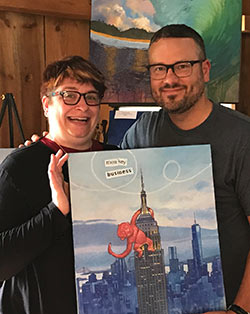
The scene was the Escape Adulthood Summit, and I had just sold one of my new oil paintings. I was elated. It had been only a year since I first offered originals for sale, and this was the first of three I’d sell in one day!
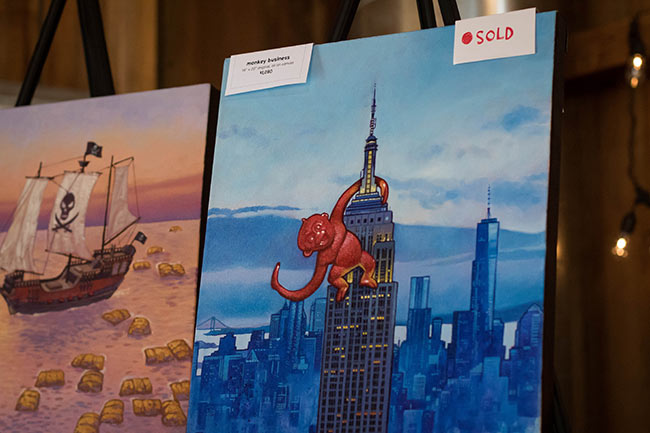
I proudly added a “sold” sign to the canvas, a badge of honor that would be on display for the rest of the event.
Later that day, I heard a disturbance in the Force. Someone had inadvertently knocked over a few of the paintings. I calmly walked over to the scene, planning to reset them on their easels. No biggie. But my gut turned upside down when I grabbed the sold painting and discovered a huge gash in the canvas. It had fallen onto — and was impaled by — a smaller easel below. The hole it created made it look like it had come face-to-face with an angry art critic named Freddy Krueger.
I was sick. Mostly for my friend Jessica, who bought the painting and was excited to have it. I groped for something to say. “Ha ha, this makes it more unique now?” I said weakly. “This comes with a great story, right?” I tried to think of a solution to save the day, but I just couldn’t. Only days earlier, I’d read about how, when artists want to be rid of a piece that they don’t like or hasn’t sold, the surest way to do the job is to slash the canvas with a knife. Yep. This felt unfixable. I didn’t see any good solution, short of refunding her money and mourning the loss of my short-lived sale.
But a little later, Jessica turned the tide with a suggestion. She noted how many of my other pieces incorporated words in a collage style, while this one didn’t. “Could you maybe add some words to it that would cover up the hole?”
Suddenly, the synapses in my brain jumped to life. A small glimmer of possibility emerged. I formed a plan.
Late that night, after a long first day of the Summit, I brought the wounded painting home and set up shop in my studio. First, I removed the varnish. Then I carefully patched up the back of the canvas with duct tape and cut out words to glue on the front. After that dried, I painted over some of the paper to blend it into the piece.
Then the moment of truth.
The gash was fixed and completely unnoticeable, but the words looked weird just floating in space. I had the idea of adding a line that traversed the sky and encircled the words to tie the painting together. But it was risky. I’d have to use an oil paint stick, with no real good way to erase it without potentially ruining the entire painting. I had one shot to get it right. After discussing it with Kim, I went for it.
A few minutes later, a little after midnight, I emerged from my laboratory with the resurrected painting. I had nailed it.
I was excited to arrive early for day two of the Summit, so I could replace the fixed painting before everyone else arrived and surprise Jess. It was fun to see her do a double-take when she realized the change. She told me she had been an art major for a brief time and suggested that the composition of the “new” painting was even better than the first. And she was right. It was a better painting in every way.
One that did come with a great story.
I’ve written before about the habit of looking at potential disasters as possibilities. I’ll admit that I was in too much shock at first to figure out any way to turn the gashed painting into a positive. I preach about “happy accidents,” but there didn’t seem to be anything happy about this one.
It would have been easy to dismiss any ideas out of hand: “That’ll never work! It’s ruined, and that’s that!” Fortunately, as hopeless as I felt, I really was open to the possibility of a happy ending. Jessica’s suggestion was the nudge I needed to find it.
Silver linings are easier to spot when you’re looking for them.
Bad things happen all the time. Unexpected, unwelcome, unfortunate, unsettling things that make us sad, frustrated, and angry. (Sometimes all of the above.) And as humans, it’s hard to bounce back immediately from these setbacks with a bulletproof positive attitude. That’s ok. It’s healthy to sulk, vent, and grieve for a spell. But it’s also healthy to be open to the idea that something good can come out of this terrible turn of events.
Sometimes that terrible turn of events delivers something that leaves us better off than we were before.
I’ve always respected the idea that Native Americans who hunted bison would put every inch of it to good use. Meat, bones, hide, everything.
As a speaker who happens to be an artist (or is that an artist who happens to be a speaker?), I love it when someone makes the most of everything we have to offer.
Oftentimes, my art gets used in the printed program and marketing materials that promote the event. Other clients give products featuring my art as thank you gifts to sponsors and volunteers. Sometimes it’s even incorporated into the stage design!
A recent client went next level, and it was awesome. Not only was I able to deliver their luncheon keynote, but they also used my art in a multitude of ways that tied my message into their event brilliantly. It’s not surprising that Baird was listed in Fortune’s 100 Best Companies to Work For, as they put a lot of effort into the small details to create a wonderful experience for their people.
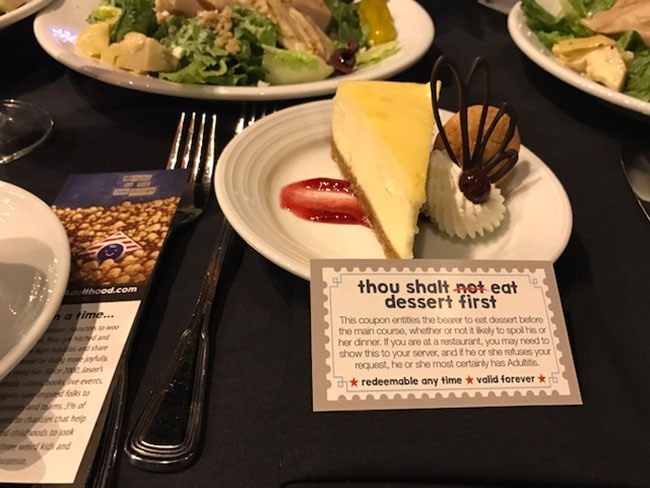
For example, Kristin, the meeting planner, coordinated with the catering team to place the yummy dessert prominently at each spot, which we complemented with fun cards we provided to encourage attendees to make it their first course.
During lunch, the big screens underscored the permission to break one of Adultitis’s favorite rules, “Thou shalt not eat dessert first.”
During my program, when I asked who had eaten dessert first, and only about 5% raised their hands, it perfectly underscored my point about how enslaved we are by Adultitis and its insidious rules that don’t exist. By identifying and breaking these so-called rules, we can take great strides in becoming more innovative and fulfilled at work and home. It was a cool way to bring everything full circle.
Meanwhile, art that was specifically chosen to complement the theme was utilized to help brand the event via signage in the registration area and on the agenda boards throughout the space.
Prints that reiterated points from my talk were included in the centerpieces at each table, and given away as fun door prizes at the end.
And at the conclusion of the program, I had a mini art show, where people could take home reminders of what most resonated with them. I love being able to chat with people afterwards, signing and personalizing their keepsakes. It’s incredibly gratifying to know that when someone buys a piece of art to hang on their wall, my message lives on beyond the sixty minutes I stood on stage.
“We were initially attracted to Jason as our luncheon keynote because his message, Breaking Rules that Don’t Exist, tied closely to our conference theme, Breaking the Mold. But we ended up with a lot more than we bargained for because, as an artist, Jason had a library of art with mini-messages that we were able to incorporate into the details of the event. His art is colorful, appealing and thought-provoking. Without it, we wouldn’t have been as successful in breaking the mold with our conference logistics.”
Kim and I love teaming up with creative, smart organizations and meeting planners who are eager to create a truly memorable multi-dimensional experience for their people!