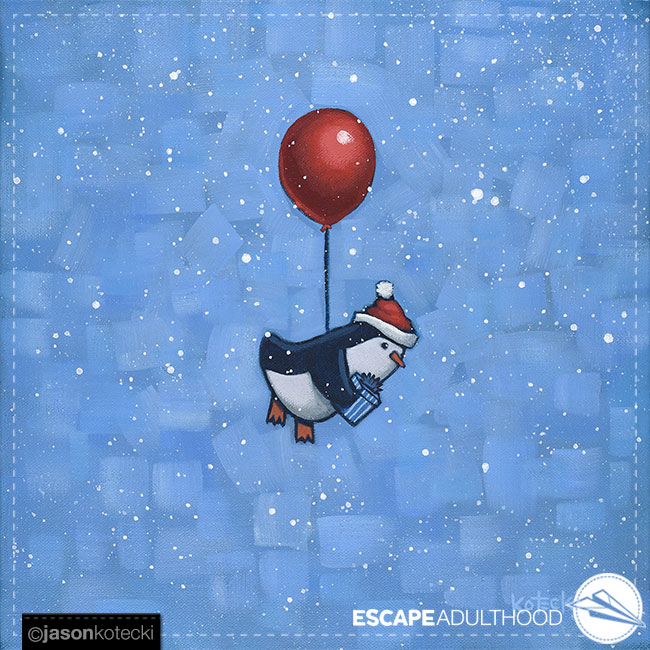
This video is a collaboration I did with American Family Insurance about 3 rules you should totally break if you are serious about achieving your dreams. Inspired by my book, Penguins Can’t Fly +39 Other Rules That Don’t Exist.
Although a little bit of structure is good when it comes to planning out your future and working towards your goals, certain ‘rules’ can hold us back. Think about it, who says you have to go about your life a certain way? Who says following the rules is the recipe for success?
Remember, everything is impossible…until it’s not.
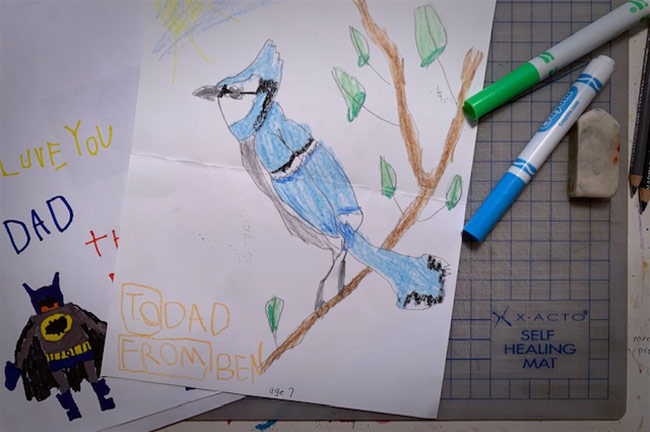
I remember one day when my son Ben signed a piece of his art with a big number 5, informing me it was “so you’ll know how old I was.”
I chuckled at the time, imagining myself adding a “40” next to my signature on each of my paintings. But I actually think it’s a good idea.
Maybe if we saw a drawing from a five-year-old Leonardo da Vinci, we’d be surprised to see that it wasn’t very good. But it wouldn’t surprise us that a drawing from when he was nine showed considerable improvement, and perhaps even contained a spark of his genius.
And maybe if we lined up all of his paintings by age, we’d more clearly see the journey he took in his career and clearly observe the process of one thing leading to another, with new discoveries opening up new areas to explore.
And maybe in the work he made as an old man, we’d see ghosts of his five-year-old self, reminding us that we really are all the ages we’ve ever been.
I spend too much time focusing on how I don’t measure up, rather than appreciating how far I’ve come. Can you relate? Too often, we measure our current self against some idealized future self, when we have already mastered the task we are about to try. Or we compare ourselves to some other person who has already spent years perfecting this skill we are only now beginning.
The worst-case scenario is that sometimes, the fear of being bad at something keeps us from even trying. Which, of course, only ensures that we will always be bad.
I recently spoke at a big conference for early childhood professionals. I asked them how they respond to their young pupils who struggle with simple math. “Do you yell at them and tell them how stupid they are? Do you say, ‘It’s ONE plus ONE, idiot…how can you not understand this, it’s soooo easy!’”
A week later, to a group of rehabilitation nurses, I asked, “What about the people who are beginning their rehab with you and struggle to perform the initial therapy exercises you prescribe? Do you belittle them, saying, “Are you kidding me? You can’t even take three steps?! What a loser; you should quit right now!”
It’s humorous to consider, and yet tragic to think about how often we say similarly hurtful things to ourselves when we start something new. Why don’t we afford ourselves the same kindness and understanding?
I think the idea of appending our age to everything we make and do would serve as a good reminder that this thing called life is a process. It’s a never-ending, slow road of growth, and sometimes that road includes wrong turns and setbacks.
You will not be as good at something today as you will be next year. But the only way to be that good is to start today. It will be hard, tedious, and frustrating. And that is ok. It’s to be expected, in fact. It’s not a sign that you’re doing it wrong; it’s proof you’re doing it right.
And someday, sooner than it feels like right now, you will look back on this day and be amazed at how far you’ve come.
Things got pretty ugly at one of my recent speaking programs.
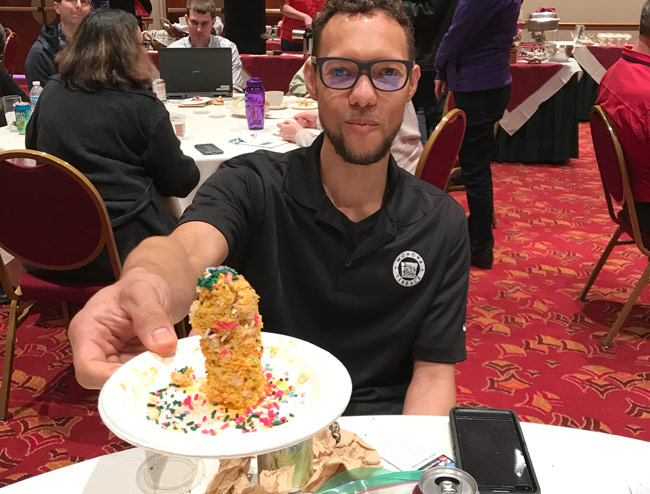
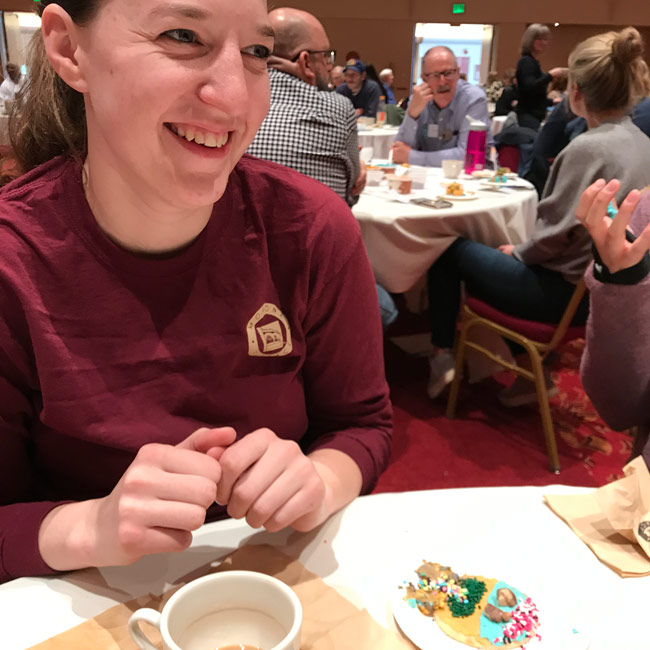
I was invited to help the staff at one of Madison’s most treasured landmarks adopt a mindset of creativity and innovation. As part of the workshop, the attendees got an opportunity to decorate cookies together. But the goal wasn’t to make Martha Stewart jealous. The goal was to make them as ugly as possible, as a callback to a story I often tell.
Mission accomplished.
Underneath this seemingly innocuous activity, several powerful elements were at play.
Chief among them was, well, play. It’s not every day that you come to work and get to decorate cookies. (Unless you work in a bakery, that is!) That alone gets people’s attention and draws them into the activity more than any predictable ice breaker activity ever could.
This level of engagement helped them to connect quickly with their co-workers, breaking down silos, as many of them work in different departments. It also drew them deeper into a follow-up discussion afterwards, where we unpacked the numerous lessons learned about the nature of innovation.
For example, the way a group can have an exponential effect on progress by building on the small ideas each person brings to the table. Or the insight that creativity is about using common things in uncommon ways, thanks to the folks who incorporated items from the breakfast spread into their creations. Or how the discomfort of taking the risks that innovation requires can be minimized by the support of teammates.
Pretty deep stuff from a few bowls of weirdly-colored frosting.
It’s a unique and memorable hands-on activity that allows the principles I present to stick, ensuring the impact lasts far beyond a single speech.
Of course, although I loved participating in the merriment and facilitating the learning, I don’t need to be present for you to win.
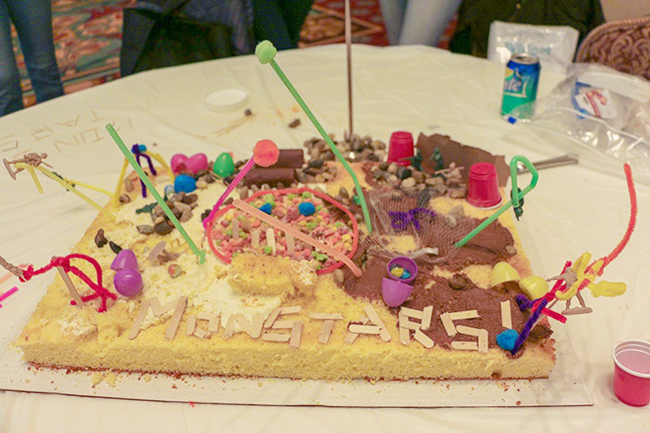
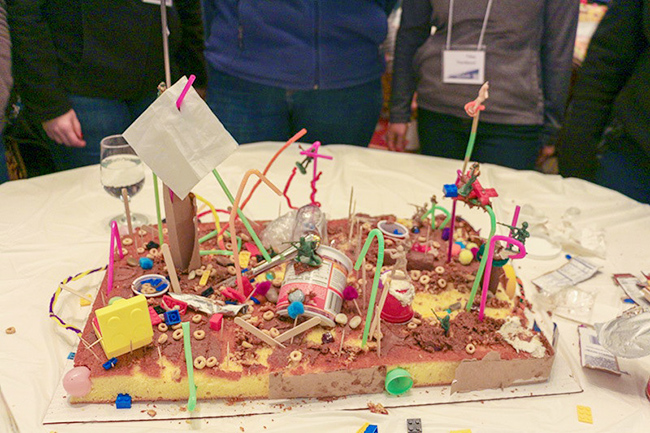
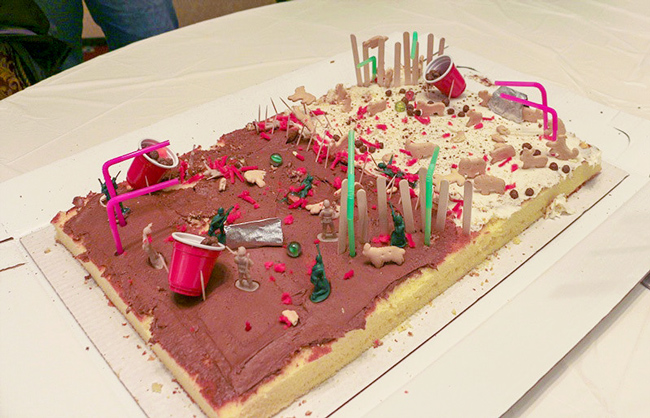
Another organization I worked with organized an “Ugly Cake Battle” at their annual training day, two years after my initial presentation. As an extra wrinkle, the staff training and development manager had the teams barter for “premiere” items, which turned out to be a big hit.
As the pictures make clear, this is an awesome team building activity that fosters creativity and is just plain fun.
Get in touch with Kim to learn more about how we can work together to create an experience your people will never forget while fostering a greater spirit of innovation in your organization!
Kim and I were invited by American Family Insurance’s DreamBank to share our story about when we returned home from vacation with our three kids to find something we were not expecting. It led to an emotional roller coaster of fear, anger, and grief, but eventually evolved into an inspiring story of hope and the power of community.
In this vulnerable but uplifting program, we share our journey from darkness into light. We also touch on themes from Jason’s newly released book, “A Chance of Awesome: How Changing the Way You See Changes Everything,” giving tips and insight for finding the silver linings amidst the dark clouds that roll into our lives.
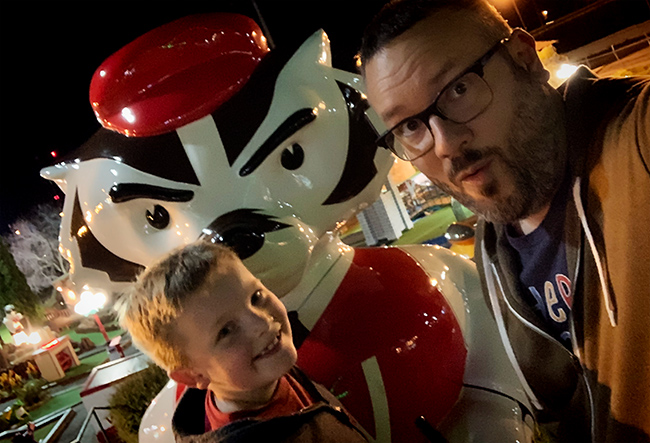
Making deposits: eating cheeseburgers, playing mini-golf, and engaging in man-to-man conversations with The Boy.
Try this: Starting today, stop making deposits into your checking account.
But continue writing checks to pay your bills.
Now, what happens when you write a check the day after your money runs out?
It’s pretty easy to see the financial lesson here. What’s interesting is that we can apply the same lesson to relationships.
So many parents tell me what a struggle it is to get their kids to do anything. They always have to get after them to get up and ready for school, do their homework, eat their vegetables, pick up after themselves, look presentable for church, etc.
It’s exhausting! Parenting is no joke, and continues to be the biggest challenge I’ve ever encountered.
I’d like to share an idea – it felt like a magic trick – I got from my wife when our kids were very young: You can’t expect to make withdrawals from your kids if you haven’t made any deposits.
Of course, all the feeding, changing diapers, sleepless nights, and providing a roof over their heads are a significant and emotionally expensive deposit. The problem is that kids don’t perceive or understand those efforts, not at that age. But there is something magical that happens when you sit on the floor with a three-year-old and let them run the show. You get on their level and let them dictate the play. You are not guiding things along to keep yourself interested, or sneaking glances at your phone as a respite from the intense boredom that develops in 17 seconds, but instead, are 100% present.
Time and time again, I was shocked at how amazingly valuable even 10 minutes spent in this way could be. There was always less pushback and more cooperation later on.
Yes, I still have to remind my kids about things from time to time. But I don’t experience the struggle many parents describe when I ask my kids to do something, and I don’t think it’s because I won the magical kid lottery. It’s because Kim and I are conscious of making deposits, not just always making withdrawals by demanding things from them. (Believe me, I have experienced the consequences when we slip.)
The thing is, this is not just a handy parenting hack. It works with every relationship the same way as it does with the bank down the street.
Toddlers. Twelve-year-olds. Teenagers. Spouses. Friends. God.
If your relationship seems dull, dying, or downright combative, it might be worth asking: when is the last time I actually made a deposit?
To be present. To ask a thoughtful question, actually listen to the answer, and then ask a follow-up question. To do something for that person that wasn’t at the top of your list of interests.
It’s the sports-agnostic wife watching a football game with her fanatical husband.
It’s the husband taking a few hours to help his wife set up her new scrapbooking room.
It’s the dad participating in a Barbie fashion show on the living room floor.
It’s the mom asking her son about the ins and outs of Minecraft.
It’s the parent sitting on the floor with a toddler, willing to be the one taking orders for a change.
If you want relationships with many happy returns, you need to make deposits first.
I’ve had people tell me that they love what they do, but they hate where they work.
When you operate in an environment where it’s difficult to find and keep good people, your culture — and an environment that supports it — matters. A lot.
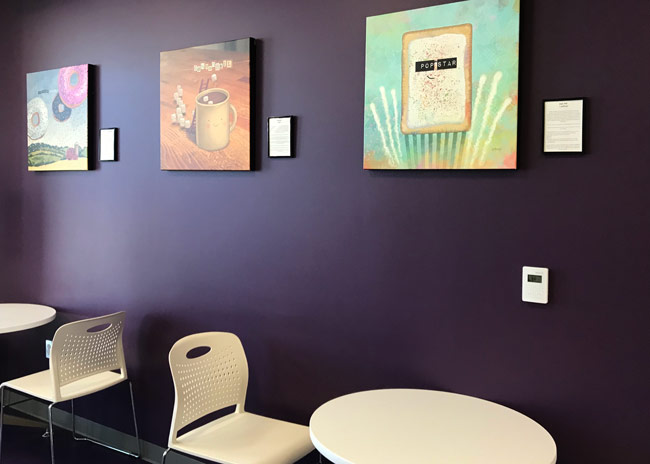
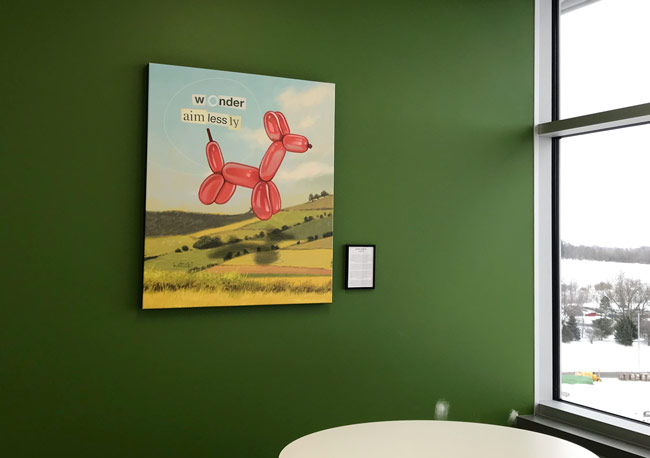
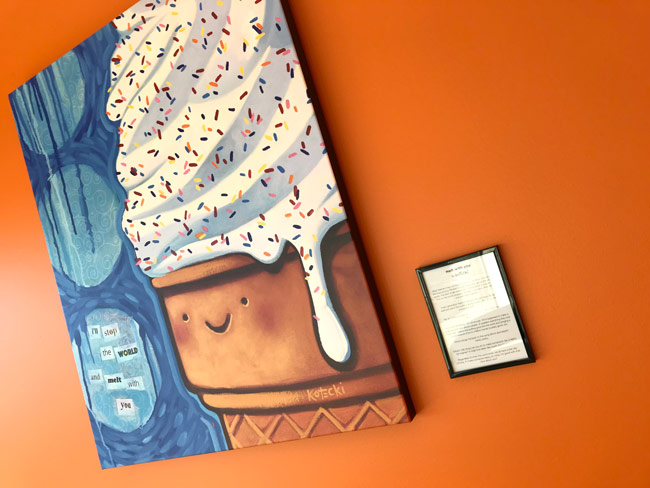
The artwork I use in my presentations does more than just serve as a pretty picture to illustrate a story. It creates a mental anchor in the mind of the participant, establishing a visual shorthand for the principle I’ve shared. Since we all think in pictures – not words – this is an extraordinarily effective way to help provide a long term impact that goes far beyond a single speech.
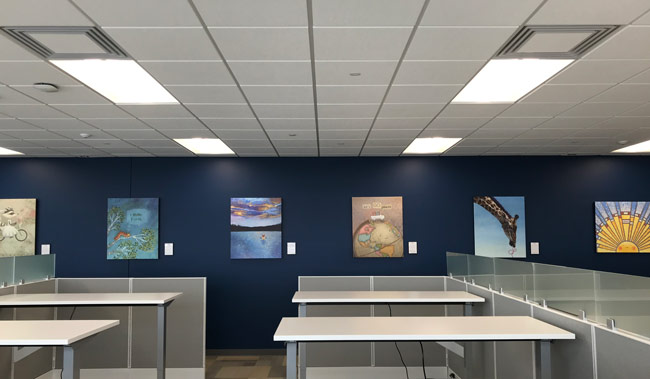
I’m thrilled that a number of smart organizations, from school districts to financial institutions, have utilized my artwork to enhance their environment and support the positive, dynamic culture they have built.
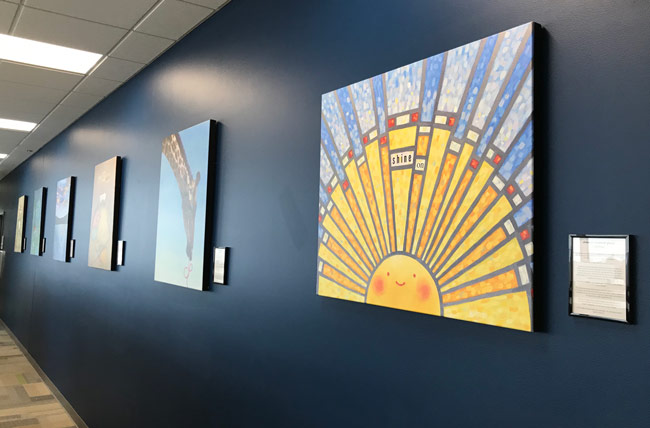
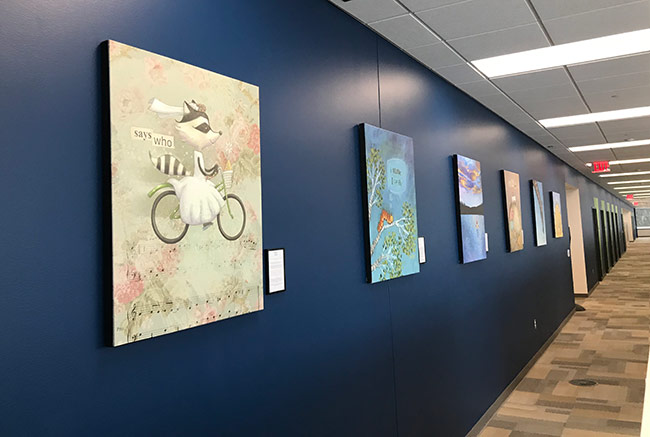
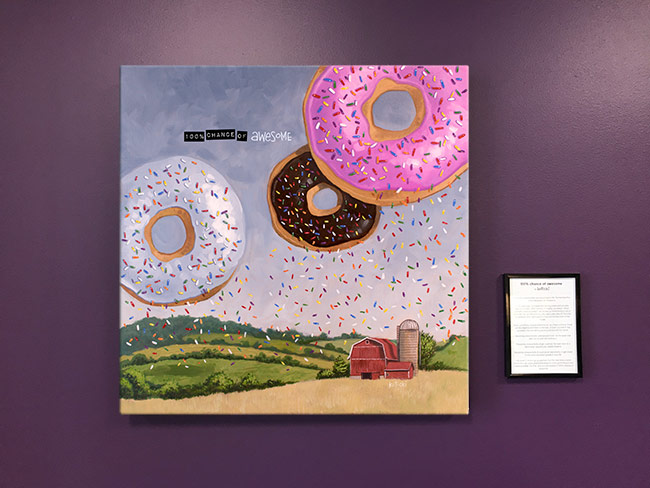
When Summit Credit Union built a new, state-of-the-art corporate office building, they were very intentional about the artwork they used to represent their culture. After speaking to their top level sales team, I was excited to be asked to collaborate with them on providing large canvas reproductions of my art that would be hung in a variety of their public and private workspaces and conference rooms.
Alongside each piece, we hung small frames that Illuminated the message behind the art. This enabled those who hadn’t heard me speak be able to connect with each piece on a deeper level, underscoring an important principle that supported the organization’s culture.
Jason’s art embodied the fun, creative and collaborative image and messages that we wanted to send to our employees. The way that Jason’s art communicates inspiring and empowering messages is how we want staff to feel when they work for Summit.”
–Heidi Duss | Manager, Wellness & Community Engagement | Summit Credit Union
In a similar way, Unity School District in Wisconsin purchased a number of pieces for their high school, middle school, elementary school, and district offices and library to enhance a recent renovation project. It brings me great joy to think about the positive influence my art is able to have on the students and faculty every single day.
If you want to change your culture, start by changing your environment.
If you are interested in acquiring artwork to take your space to the next level, I invite you to explore the range of images available and email Kim to discuss the many options we have available.
Eating lobster used to be a punishment reserved for prisoners.
I was reminded of this during a recent trip to New England. I had a speaking engagement in Connecticut, and took my oldest daughter with me. I had three different lobster dishes on the trip (in between samplings of clam chowd-ah).
The fact that the inclusion of lobster makes any dish more expensive is quite a turn of events from its humble beginnings. A few hundred years ago, lobsters were plentiful, washing up on shore by the hundreds. The so-called “cockroach of the sea” was eaten only by the poor and prisoners, who considered it a cruel and unusual punishment. It was commonly used as livestock feed and fertilizer. Said essayist John J. Rowan in 1876, “Lobster shells about a house are looked upon as signs of poverty and degradation.”
But in the late 19th century, canning became a viable way to get food rations to soldiers in the Civil War. Enterprising railway companies rebranded the lobster as an exotic dish to travelers in fine dining cars far from the coast. Soon, fresh lobster became more desirable. The newfound popularity increased demand, reducing supply and driving prices higher.
That’s how lobster went from prison food to pricey delicacy.
It’s also an example of how changing the way you see changes everything. A more modern, crustacean-free example comes via an email I received from a reader named Melissa. She and her family have been going through a turbulent time, between unexpected repairs popping up in their vehicles, to some unwanted pests taking up residence in their home. It’s been stressful, to say the least. She wrote:
“What I learned by watching my husband’s example, was to intentionally have fun in the midst of all this. I’ve been saying YES to more little requests than usual in order to combat the stress: yes, let’s get ice cream; yes let’s go to the park; yes let’s play with water balloons; yes let’s go on that unplanned weekend away with the cousins; yes, we can bake cookies again. I think my children may think having pests in the house has been one of funnest times of their childhood… and thinking back on this time I wonder if I will remember the pests or only the fun we had.”
I think we all know the answer to that.
You can’t wish away stress or prevent difficult challenges from invading your everyday, but you can control how you frame it. Melissa and her husband reframed their trials into treasured memories for their kids.
This ability to reframe is not some Pollyanna technique for making you feel good. As the examples above demonstrate, it can literally create money out of thin air and produce happiness from frustration.
This is the entire premise of my new book, A Chance of Awesome: How Changing the Way You See Changes Everything. If you’d like to get better at this skill, you might want to pick up a copy for yourself.
The important thing is to keep in mind that if you’re looking for a new way to grow your business, solve a tricky puzzle, or overcome a hardship, you might want to try looking at it from a different perspective.
In my book Penguins Can’t Fly, I wrote about the story of a young man I knew who had leukemia, and how his family and friends moved up Christmas a few months so he’d be able to celebrate his favorite holiday one more time.
Well, unbeknownst to me, one of my speaking colleagues was good friends with Kevin’s mom. One day, shortly after the book came out, my colleague read her the passage in my book.
Through the tears, Kevin’s mother expressed her great joy in finally having something new to share about her son. “My friends are always telling me new things about their kids,” she said. “How they graduated with honors, got married, and had their first child. I never had anything new to share. Now I do.”
The other thing this mother told my friend was how sad she was that no one ever brought up Kevin in conversation. Oh, she knew it was because they were being sensitive and didn’t want to upset her. “What they don’t realize,” she explained, “Is that I want to talk about my son. I want to remember him. I want this memory to be kept alive through stories.”
I’ll admit that I would tend to err on the side of silence, for fear of kicking up sad emotions. But after hearing her perspective, I knew she was certainly not alone.
This time of year can be hard for many people who are missing loved ones.
I’m hoping that sharing this little insight might be helpful to someone reading this. Maybe, just maybe, the best way to shine a little light into someone’s holiday season is by illuminating the life of a loved one who has passed away, through a simple story,a fun anecdote, or something new that happened that made you remember them and smile.
“Sometimes memories sneak out of my eyes and roll down my cheeks.”
Well, we’re here. Even though Christmas music has been playing in stores since Halloween, the passing of Thanksgiving officially puts us into the holiday season, ready or not. (How is it that companies can promote week-long Black “Friday” deals with a straight face?)
I have a secret to share with you. Every bit of advice I give, or moral behind a story I tell, is mostly for me. They help keep me accountable and on track in my own fight against Adultitis. And as a professional reminder-er, I’d like to take this time to share some reminders for all of us. I, for one, need this particular reminder every year around this time.
You may or may not be surprised to know that this is one of Adultitis’s favorite times of year (right up there with April 15th, aka Tax Day). Of course, the reason has nothing to do with holly jolly elves or goodwill toward men. No, it thrives on the frenzy we find ourselves in. It uses the busyness and obligations to stress us out, wear us down, and, most importantly, distract us from the things that really matter.
Yes, for many of us, there are trees to trim, decorations to put up, gifts to purchase, cards to send, office parties to attend, cookies to bake, crowds to navigate, presents to wrap, miles to be traversed, groceries to buy, meals to prepare, snow to shovel, rooms to clean, in-laws to suffer, and to-do lists to be tackled.
It’s prime feeding ground for Adultitis. It may seem impossible to avoid it.
But not if you remember that there are also memories to be made, cookies to be eaten, jokes to tell, ho ho hos to be hollered, bells to jingle, carols to be crooned, laughs to be shared, cardboard boxes to be transformed into castles, and (depending on where you live) snowflakes to catch on your tongue.
Spending at least as much time on the second list as you do on the first is the equivalent of rewarding Adultitis with a stocking filled with coal.
When I walk through a cemetery, I look for stories in the gravestones. Sometimes the markers are very large and ornate, and other times quite small and humble. I wonder how accurate they are in reflecting the greatness of the lives they represent. Sometimes there are bible verses, or a few descriptors, like “devoted husband, father, and friend.” Sometimes there are mentions of military service, and I imagine the horrors witnessed and the heroics performed. Sometimes the date span is much too short, a sad memorial to the life of a baby taken from our world too soon.
But something about gravestones like this one is extra poignant.
“Till death do us part.” This is a promise Lois and Albert made to one another a long time ago, on their wedding day.
Albert’s story is finished, in this world, at least. Something about the dates being carved in stone makes it so real and permanent.
But Lois, her life feels like it’s on pause. A cliffhanger. Like someone with a chisel is waiting in the wings, at the ready to stamp that second date under her name, completing the story of this gravestone.
Fifteen years have passed since Albert’s death and me taking this photograph. I don’t know either of them, but I can’t help but wonder what Lois is up to now. Is she happy? Still grieving? Or maybe both? Does she live alone, or with family, or perhaps in a nursing home? Has she made the most of this time she’s been given before reuniting with the love of her life?
I wonder what it would be like if, once we reached a certain age, acquiring our gravestones was mandatory, with the birthdate stamped in granite. Like when we get our driver’s license, or before we can vote.
It’s easy to pretend that death is something that happens to other people, or at the very least, to people much older than us. But just the idea of having a physical block of stone, with our name and birthdate on it – with the second date still unknown – would that change anything about how we live our lives today? Maybe not. But maybe…
Maybe it would be easier to put things in an eternal perspective and cast aside our trivial worries and concerns.
Maybe it would be easier to remember that buying that shiny new thing isn’t going to make us all that happier in the long run.
Maybe it would be more obvious to us that most of the things that clutter our to-do lists are pretty inconsequential, and that the neglected or damaged parts of our relationships are really where we should be spending our time.
Maybe it would be easier to give a little grace to our parents, spouse, or sibling, overlooking their annoying habits and forgiving the transgression that grieves us so.
Maybe it would crystallize what we’re put on this earth to do, rather than pretend we’re uncertain simply because we’re too afraid to decide or take the first step.
Maybe knowing that the final date could be stamped in at any moment would force us to really slow down, bringing into focus the beauty and blessings that too often fly by, unnoticed in our hurried existence.
For a whole host of reasons, it’s probably impractical to make people acquire their gravestones early. But you can imagine your own, right now: It’s hard, cold, and extremely heavy. Your name is chiseled on the top in big, capital letters. Below that, you can run your fingers across the four numbers that indicate the year you were born, feeling the sharp edges and deep indents in the stone where it is carved. But to the right of that date is nothing but smooth, polished granite.
For now.
You’re in the midst of life’s great cliffhanger. What will you do next?