Author: Jason

  • Are You Living a Lie?

    Kim and I recently realized we’ve been living a lie.

    Allow me to explain.

    Being close to water has always been high on our list of values. We dreamed of living on a lake since our earliest days together. When we lived in Madison and worked toward that goal, we spent a lot of time enjoying the four lakes that embraced the city. When we went on vacation, we faithfully followed a rule: make a point to get a place on the water.

    Well, we recently spent a long weekend in Door County, and once we cleared space on the calendar, the next step was securing lodging. Naturally, Kim’s knee-jerk reaction was to start looking for a place on the water.

    But then we talked about it. Now that we are fortunate to live on a lake and can enjoy campfires in our own backyard, the importance of renting a place on the water is no longer a high priority.

    We realized we were operating with a premise that was no longer true.

    Are you currently making choices based on something that used to be true, but is no longer?

    Is a goal that drove you in your twenties a little less important now that you have a family, or feels a little less interesting now that you’ve explored it a bit?

    Are you spending time or money maintaining something useful ten years ago when the kids were younger, but now no longer need it?

    Are you still abiding by a preference that mattered a lot to someone who is no longer in your life?

    Are you still volunteering with an organization that no longer aligns with your values or requires more time than you can give in this season of your life?

    Does your business still serve a demographic that is no longer a good fit for the current strengths and solutions you offer?

    If you answered yes to any of these questions, hear this: it doesn’t mean that your original decisions were wrong. Seasons change. We learn and grow and evolve. We are allowed to change our minds, especially when circumstances change.

    In fact, we should.

    But we often hold on too long, wasting time and resources on something that is no longer serving us.

    Why do we do this?

    Sometimes it’s hard to say goodbye to happy seasons of life.

    Sometimes it’s hard to move beyond the sunk costs of time, energy, and money we’ve invested.

    Sometimes it’s just a habit or routine that’s become a rut because it hasn’t been evaluated in a while.

    That was the case for me and Kim.

    Realizing that renting a place on the water wasn’t as important gave us more options for lodging that could work, which, not surprisingly, were way more affordable. (Which is good, because the cost of feeding our clan is now much more expensive!)

    Granted, our example is pretty pedestrian in the grand scheme of things.

    But in any case, the cost of living a lie is always more expensive.


    🤔 I wonder…are you making any choices based on something that used to be true but no longer is?

  • The Freedom in Hard Choices

    Once upon a time, there was a couple. They had three kids and a good life. He made his living as an accountant, and she was a doctor, but their real dream was to live on a ranch and breed dogs.

    One day, my wife Kim suggested they do that. 

    The woman laughed. “It’s not possible,” she said.

    And so they didn’t.

    The end.

    This is a true story, and similar stories just like it are lived out every day.

    Of course, the woman was wrong about it not being possible. Oh, she gave a list of reasons, but none of them made the option impossible. Risky, perhaps, or unconventional, or difficult, or impractical, or scary, or all of the above.

    But certainly not impossible.

    I feel sad for them. Are they settling for comfort? Worried about what other people would think? Afraid of the unknown? Only they know for sure, but they appear resigned to turn down a chance at the literal life of their dreams.

    Of course, the choice is theirs.

    Unfortunately, the regret they may someday experience will also be theirs.

    It’s a shame how willingly we surrender the direction and, ultimately, the outcome of our lives to other people and to rules that don’t exist.

    Of course, sometimes we do encounter real, indelible limitations that hold us back from the life of our dreams, but they are far fewer in number than we think. Our opinions, traditions, and customs can be so strong that they feel a lot like moral obligations. But that doesn’t necessarily make them so. We still have a choice.

    Hard choices are still choices.

    When we are facing hard choices in our own lives, pretending like we don’t have a say in the matter gives us cover by removing the responsibility for the decision. Things didn’t work out? Don’t blame me; I didn’t have a choice.

    The truth is, you actually did.

    I know men who hate their jobs. But they stay put. They say it’s because they need to act responsibly as the provider for their family, which is honorable. They resolve to stick it out until retirement, or until the kids are grown. Meanwhile, their persistent unhappiness hangs like a black cloud over the entire family.

    This is not to say that work is always enjoyable or imminently fulfilling. And should they risk it all by quitting their job in a blaze of glory? Probably not. But is that really the only option? Couldn’t they keep their job while they send their resume to other potential employers? Couldn’t they start a side hustle and see if it has legs? Couldn’t they take some night classes to learn a new skill?

    The answers are all “yes,” but none of that is as easy as acting as if you had no choice.

    When making decisions, we can be swayed by fear, guilt, practicality, common sense, or simply the force of habit. And those forces can make it seem like we have no say in the matter. But we always do.

    Meanwhile, other people have all sorts of opinions about how we should live our lives and are quick to weigh in on what we should or shouldn’t do. Depending on who’s doing the opining, those “shoulds” can feel pretty heavy and unbending.

    It’s wise to seek the counsel of our elders, the ones who have seen more things and have been in the fight longer than we have. But ultimately, we are allowed to chart our own path, even if it goes against the wishes of our parents or our peers.

    In the times we feel trapped in a life we didn’t sign up for, it’s important to remember that we have more agency over our lives than Adultitis would like us to believe. As C.S. Lewis wrote, “The doors of hell are locked on the inside.”

    Maybe the path your heart is urging you toward makes no practical sense.

    Maybe it will disappoint someone you care about.

    Maybe the chances of success are somewhere between slim and nil.

    It might not work. But…what if it does? And what do you lose by not even trying?

    “A ship in harbor is safe, but that is not what ships are built for.”—John A. Shedd

    You only get one life, and at the end of the day, you are the captain of it.

    Hard choices are still choices.

    Choose wisely.


    🤔 I wonder…what is something difficult you’ve accomplished in your life that seemed impossible at first?

  • Lessons From Wondernite

    Our fifth Wondernite is in the books. Between that and the Wonder & Whimsy Society Family Reunion we hosted in our backyard the day after, I’m still in introvert recharge mode. I recently discovered that as an Enneagram 5 wing 4, my internal battery is like that of a ten-year-old smartphone: it’s not capable of ever achieving a full charge, and it drains really fast, especially if it’s doing processor-intensive tasks, like streaming video, or, you know, hosting back-to-back live events with hundreds of people.

    This week I thought I’d share some thoughts and lessons from “behind the scenes.”

    Putting together Wondernite is like planning a wedding, but with lots of painting, writing, photographing, varnishing, and framing involved. There is so much thinking, strategizing, and vendor communication, along with hours of setting up, and it’s all over in a blink. We try to make it as efficient as possible, but it’s still a lot.

    🌙 Lesson: Anything worth doing well takes effort. You can make a meal in a microwave, but it’s never as good as a home-cooked meal made from scratch.

    Along those lines, I spent two months writing, polishing, and practicing a talk that, technically, I will only give once. Meanwhile, some decisions were made quickly, and other details were completely overlooked. A while ago, I determined that the talk is the most important aspect of the evening. The more effort I put into it, the more likely people will connect with the art, and the more likely they will walk away inspired, uplifted, and encouraged, which is my main goal. It also makes them more likely to return with friends.

    🌙 Lesson: It’s important to figure out what’s important and avoid wasting time on stuff that isn’t. Don’t major in the minors.

    I said “technically” when I mentioned giving my talk once. Although I will not deliver the same stories in the same way again, I can repurpose the work elsewhere. I can use them in future keynote speeches, depending on the theme and message I’m trying to communicate. I’ll also be sharing each one here in the Insider over the next seven weeks. An art mentor of mine calls this “getting all the meat off the bone.”

    🌙 Lesson: The next time you put a lot of effort into creating something, ask yourself, “Now that I have this, what does this make possible?” How can you reuse, recycle, or repurpose work you’ve already done into something else that’s useful?

    Wondernite has live and silent auction components, and yes, it’s kind of uncomfortable when an item doesn’t receive even one bid. My son was not happy about it, but I’m used to it because I know that it has nothing to do with me or even my skill as an artist. You never know what will resonate with people. Sometimes somebody falls in love with a work you don’t much care for or a painting you knocked out in an afternoon as an afterthought. Sometimes, no one looks twice at a piece you think is your masterpiece. And yes, sometimes you think a painting will strike a chord…and it does! (Like “Not a Morning Person,” seen above.)

    🌙 Lesson: No matter what you’re in the process of creating — whether it’s a painting, a new initiative at work, or a lesson plan for a classroom of students — the results are not in your hands. You don’t get to decide on how other people respond. All you can do is the best you can do with what you have.

    With an event like this, it’s hard to decide what success looks like. The obvious measuring stick is money. How much revenue did we generate? Was it profitable? I’m still sorting through the numbers, but it looks like we edged out last year, which is great. But…should I feel disappointed that we didn’t exceed it by a greater number? What about profit? Well, on paper, we made a lot more than we spent. But that doesn’t factor in labor, which one could argue makes it ridiculously unprofitable and a complete waste of time. But then again, how does one measure the satisfaction of seeing the smiles, laughs, tears, and heartfelt thank yous that emerged from an event you created and art you made with your own two hands? Hmmm…now that’s a little harder to put a price tag on.

    🌙 Lesson:  I had the pleasure of attending a speech by Tom Monaghan, founder of Domino’s Pizza and former owner of the Detroit Tigers, and he said he knows a lot of very unhappy billionaires. Success comes in many different flavors. You get to decide what success looks like for you, and you don’t have to settle for the default setting.

    In more ways than one, Wondernite is a dream come true and a success on many fronts. Thank you to everyone who attended, participated in the online auction, and helped behind the scenes to make it happen!

    Now, if you’ll excuse me, it’s time for a nap.

  • Things That Aren’t Supposed to Happen

    Things that aren’t supposed to happen are happening all the time. 

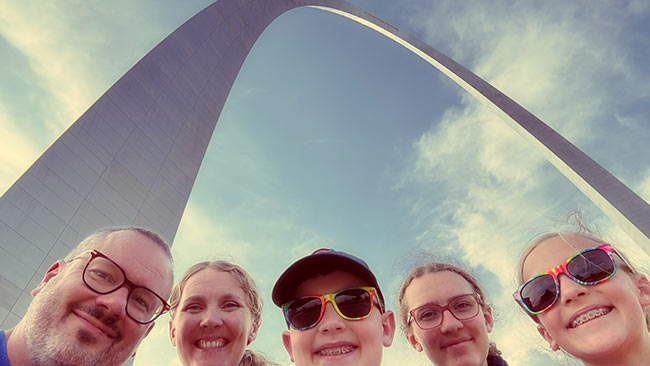
    One such happening was the construction of the Gateway Arch in St. Louis, which my family had the chance to visit this summer. Its very existence was considered an impossibility by some very smart people.

    The Arch was dreamed up by architect Eero Saarinen in 1947 as part of a design competition to build a monument to the westward expansion of the United States. Although his design won unanimously, construction did not begin until 16 years later, in 1963.

    There were many reasons for the delay, including funding challenges and lawsuits. Based on the political gridlock alone, one could hardly have been blamed for doubting the success of the project. However, many experts even doubted whether the design itself was feasible.

    The use of stainless steel as the primary material for the arch was a novel concept at the time. Concerns were raised about the durability and construction methods required to use it to build such a large structure. The idea of building such a tall and slender free-standing arch had never been attempted before, leading to doubts about its structural integrity and stability. The arch’s height and shape meant that precise engineering and construction techniques were essential to prevent collapse during and after construction.

    These significant challenges caused many people to believe that although Saarinen had a beautiful design, it was not going to work in the real world.

    There were many hurdles in the construction of the Gateway Arch, but the biggest obstacles may have been the ones in people’s minds.

    Keep in mind that the doubters were not just random citizens. They were smart, well-educated engineers with very good reasons for their skepticism. They most certainly believed they were right. And yet…

    …they were wrong.

    Educated guesses can only take you so far. Even the very educated ones.

    Sometimes the meteorologist forecasts it will rain, and it doesn’t.

    Sometimes the polls and pundits are spectacularly wrong about the outcome of an election.

    Sometimes the team that sportswriters unanimously agree is far superior ends up losing the game.

    Sometimes the medical expert who gives a patient two months to live is off by decades.

    It was predicted that 13 people would lose their lives in the process of building The Arch. No doubt, at 630 feet tall, it was a perilous undertaking. But in the end, not one life was lost.

    On any given day, it seems self-evident that current events are pointing to an inevitable outcome. It’s worth remembering that when the Soviet Union was at the height of its power, World War III looked inevitable. And yet the empire ultimately crumbled without a single missile being fired.

    The only thing we can be sure of is that the future will be filled with things we never saw coming.

    So what is there for us to learn from the experts Eero Saarinen and his construction team proved wrong?

    First, don’t get too cocky about your own educated guesses. You think you know what the future holds? Your life could change forever in a heartbeat.

    And secondly, don’t let the educated guesses of others thwart your plans or rob you of hope. Parents, politicians, pundits, pop stars, and well-educated professionals of all stripes are more than willing to opine on your future. They might well be experts.

    But they might also be wrong.

    Things that aren’t supposed to happen are happening all the time. 
  • Are You Taking a Trip or a Vacation?

    If you’re planning to travel this summer, are you taking a trip or a vacation?

    One isn’t necessarily better than the other, but it’s worth making the distinction.

    A trip is a type of travel with an agenda. There are scheduled events to plan for. Places to be or people to see. Lots of moving around. Trips can be exciting and fun and fulfilling, but they don’t usually leave you feeling rested. If you’ve ever returned from someplace and said, “I need another vacation to recover from my vacation,” you weren’t on a vacation. You were on a trip.

    A vacation is much less regimented. Aside from a few planned activities, your agenda is more wide open. It’s more relaxed. There is nowhere you have to be. This type of travel doesn’t usually have an abundance of photos or adventure stories to share, and often feels like you did a whole lot of nothing, but you return home refreshed.

    Our family went to Yellowstone National Park for a week. We did a lot of driving, stopping, looking, and hiking. There wasn’t a whole lot of time just “being.” We saw things we’d never seen before and came back tired, with a hard drive filled with photos and heads overflowing with stories. It was great. But it was definitely a trip. A visit to Disney World or a pilgrimage to Rome is also a trip.

    Later that year, we went to Hawaii. I had a speaking engagement in Honolulu, and we spent a few days there (a trip) before hopping over to Kauai for a week (a vacation). We gave ourselves permission to not do and see everything the island had to offer, opting instead for long stretches of beach time. There was less movement, lots of sleeping in, fewer “have to’s,” and not nearly as many photos. But we filled our cups and came back rejuvenated.

    An aside: Some may presume or argue that travel with kids is always a trip, not a vacation. I find this generally true, but I recall a few treks to Florida when the kids were very young, when the bulk of our time was spent on the beach, playing in the sand, and tricking the waves. Kim and I left work at home, relaxed our expectations, focused on enjoying the little ones, and sipped tropical drinks when they went to bed. It was quite restorative. On the other hand, the subsequent cross-country road trip to the Grand Canyon a few years later was fun, but undoubtedly a trip. ]

    Of course, it’s possible to take a vacation in Yellowstone or turn Hawaii into a trip. And everybody has varied personal preferences when it comes to how we recharge our batteries.

    The point is, there’s a definite distinction between a trip and a vacation.

    The problem is when you take one but expect (or need) the other.

    Before I realized the distinction, I found it tempting to resent a trip I went on because it didn’t turn out to be a vacation. Which totally discounted all the cool things I experienced. Likewise, finding yourself disappointed with a vacation because it didn’t have the adventure of a trip can also be frustrating.

    So if you’re in the process of making some travel plans this summer, be mindful of whether you need a trip or a vacation.

    And if something is already on the calendar, determine whether it’s a trip or a vacation in advance to set proper expectations, minimize Adultitis, and make the most of the opportunity in front of you.

    Happy travels!

  • Something Wonderful is About to Happen

    Do you feel it?

    It’s subtle, but if you quiet yourself just enough, you may be able to pick up the vibrations of a slow build of energy gaining momentum. The timing is uncertain. It might be tomorrow. It might be next week. It won’t be long.

    Something wonderful is about to happen.

    It’s hard to pinpoint just what it will be, but that’s part of what makes it so tantalizing. It could be anything! It might be life-changing. It might be small but immensely satisfying. It might be a total surprise or an answered prayer that’s been a long time coming. The only certainty is that it will be wonderful.

    Please understand that I’m not talking to some random reader, some other nameless, faceless person. This message is for you — yes YOU — the one reading these very words right this moment.

    I know it may be hard to believe. After all, I see the headlines. I am aware of all the division. I’ve experienced the ever-present darkness that suffocates joy. Perhaps life has been delivering you a steady diet of curveballs. Maybe you’re in the middle of a downpour that just won’t stop.

    All the more reason to stay alert.

    Because something wonderful is about to happen.

    One of the best parts of a vacation is the anticipation, the looking forward to being off work or out of school, and all of the adventures to be had. Get yourself in the mindset of a young child on Christmas Eve, too delirious to sleep. Trust me, it’s impossible to get too excited about what’s on the horizon. Feel free to let your imagination run wild, because it’s no match for what’s coming.

    Don’t worry. You won’t miss it, as long as you’re paying attention.

    Lift your head. Focus your eyes. Open your heart.

    Something wonderful is about to happen.
  • The Problem with Pursuing Happiness

    Maybe Thomas Jefferson made a mistake.

    Maybe he never should have incorporated that line from John Locke into the Declaration of Independence, the one about the “pursuit of happiness.”

    Nothing wrong with happiness, of course. Everyone wants it be happy.

    It’s the pursuit that gets us into trouble.

    In the movie Jesus Revolution, the free-spirited Lonnie Frisbee has a conversation with a conservative pastor who is suspicious of hippies. Lonnie admits, “We might seem a little strange, but if you look deeper, if you look with love, you’ll see a group of kids searching for all the right things, just in all the wrong places.”

    How often does that also apply to us? Our pursuits go beyond drugs, sex, and rock & roll. We are busy, busy, busy with overflowing calendars, living in homes bursting with stuff. In our pursuit of happiness, we chase… 

    Pleasure.
    Promotions.
    Grades.
    Affirmation.
    Fame.
    Wealth.
    Security.
    Comfort.

    All this pursuit, and what does it get us?

    Exhausted. Burned out. Riddled with Adultitis and nowhere closer to happiness than when we began.

    Our pursuit of happiness has us on a treadmill. We keep walking and walking and walking, accumulating more stuff, achieving more goals, and checking off more things on our bucket lists. And just like a treadmill, no matter how much effort we put in, we remain in the exact same spot, looking for the next thing to pursue.

    Maybe another American can provide a solution. Novelist and short story writer Nathaniel Hawthorne said, “Happiness is like a butterfly which, when pursued, is always beyond our grasp, but, if you will sit down quietly, may alight upon you.”

    I experience this time and again in my own life. I can be stressed and overwhelmed, worried about finances, concerned about the health of one of my kids, and frustrated that my schedule for the day just got blown to smithereens.

    But after five minutes on the healing swing in our backyard, recalibrating my heart and soul with the pulse of God’s creation, all is well with the world. Or when I take a few minutes to review my last month’s worth of Happy Moments, suddenly happiness is right beside me.

    Happiness can feel elusive sometimes, but it’s quite simple:

    Spend time in nature.
    Count your blessings.
    Detach from sources of negativity and dwell on the positive.
    Look at things from a higher, eternal perspective.

    The prerequisite is getting off the treadmill. 

    Our problem is not our desire for happiness, it’s our inability to sit still.

    Happiness is not something you have to pursue. It is right beside you, and it’s been there all along.

    It’s just waiting for you to pause your pursuit long enough to notice.


    🤔 I wonder…what is something you’re happy about right now?

  • An Inconvenient & Unappetizing Truth

    The truth will set you free.

    Unfortunately, it’s rarely convenient and often appears unappetizing.

    I was moderating a panel on work-life balance for a group of engineers. Four experienced veterans were sharing insights to help these future leaders achieve a new level of growth. The following morning, with the panelists gone, I facilitated a discussion about what was shared the evening before. I asked for examples of advice that resonated as well as any sentiments they disagreed with.

    One young man raised his hand and admitted, “I guess I was disappointed that the answer to better life balance always seemed to be ‘to delegate.’ I wish there were other ideas given.”I smiled, acknowledging that delegation was a consistent theme from the panel. The reason for the emphasis on delegation wasn’t because the panelists were lazy and didn’t want to think any more about it, or that they were withholding the real answer to maintain their lofty status. It’s because it was the best answer. The most useful one. The one guaranteed to have the biggest difference.

    It’s also the hardest.

    Delegation is a difficult skill to master. Knowing how to ask for what you need, set and manage expectations, and provide guidance without micromanaging is nowhere close to easy. It’s even more challenging if you are a perfectionist and loathe giving up control (as most of these overachievers were). But, to get to the next level of their career and maintain some semblance of balance, delegation is the master key.

    It’s just not a very appetizing answer.

    It’s like asking one hundred experts how to lose weight and being disappointed that the answer repeated again and again was “eat less and exercise more.” It’s the best answer, but also very hard. 

    Dissatisfied, we are compelled to search for another answer, something faster and easier. We can usually find an “expert” who will tell us what we want to hear, the secret that can be had for three easy payments. It’s one reason pharmaceutical companies have grown so rich and powerful: they know we can’t resist the lure of a pill to solve all our problems. 

    So what about you?

    What transformation would you most like to achieve? What’s the biggest challenge in your life right now? What obstacle do you want to overcome? 

    Shed fifty pounds?

    Find a more fulfilling job?

    Finally write that book?

    Turn that side hustle into a real business?

    Achieve more balance in your life?

    What’s the secret to making it happen? The secret is that you probably already know the answer. (Or at least how to begin.)

    And it’s not very appetizing. It’s difficult. Slow. Boring.

    Sure, you could keep looking for something easier, quicker, or sexier.

    Or you could save yourself a lot of time and just get to work.

    The truth will set you free.

    🤔 I wonder…what unappetizing truth do you most need to accept to move forward and grow?

  • One Last Time

    The two angels in the back row wearing yellow t-shirts and gold tinsel halos were mine.

    My two youngest kids were in a musical as part of our homeschool co-op. It was the first time on stage for both of them. We went to both performances and they did great!

    Naturally, opening night was filled with nervous excitement and hyperactive butterflies. There were no noticeable gaffs or forgotten lines from anyone. It was an impressive effort.

    The second day was different. Still good, but some missed cues and forgotten lines that added awkward uncomfortability.

    One might think the second night should have been better because the cast is even more experienced (even if only by one performance) and they have the confidence from proving to themselves that they could do well in front of a live audience.

    I have a theory for this drop-off. The reason night one of the play was better was that the nervous energy kept them sharp. Perhaps the confidence from nailing the first performance led to cockiness, fooling them into thinking they could coast on the second show, causing them to lose their focus.

    Of course, these are kids I’m talking about. Amateurs. They really did an amazing job. But they gave me an example we can all learn from. You see, the reason for my confidence in my assessment is because I have experienced it.

    In my career of over one thousand speeches, there have been moments when I caught myself going through the motions. The speech was fine, but it wasn’t great. I forgot some good lines. I wasn’t as sharp on a few stories as I could have been. I like to think the audience never noticed, but they probably did. Even if they didn’t, I robbed them of something better.

    At some point, I changed my mindset, and it has made all the difference.

    As I get close to taking the stage, I now act as if this is the last speech I’ll ever give. This simple reframe helps me filter out a lot of noise. It keeps me from looking ahead to the next speech and comparing this audience to the last one. None of it matters anymore, because this is it.

    This technique helps keep me from taking any of it for granted. My performance, and the audience I’m serving, are better off because of it.

    We can never recapture the butterflies and excitement of the first time we do something. But we can resurrect some of the electricity and intentionality of that experience by considering it might be the last time we do it.

    What if this is the last class you’ll ever teach?
    What if this is the last meal you’ll ever prepare?
    What if this is the last table you’ll ever build?
    What if this is the last patient you’ll ever serve?
    What if this is the last person you’ll ever help?

    It takes significant effort to put yourself in this headspace each time. But what a difference it makes in your ability to focus and be fully present in the moment.

    Yes, in a certain respect, you’re tricking your brain over and over again.

    But the truth is, one of these days you’ll be right.


    🤔 I wonder…what is something you do often that could benefit from a mindset shift like this?

  • The Ogres in Maine

    There are ogres in Maine.

    My daughter Lucy and I were there for a speaking engagement in Portland. We spent some free time visiting the lighthouse, and Lucy paused to photograph some plants she saw along our path. (She is her mother’s daughter!)

    Then, a crabby ogre emerged over the cliff. Her vile breath slapped us in the face as she bellowed through rotten teeth, “That’s GARLIC MUSTARD. It’s a TERRIBLE weed!” And just like that, she disappeared from view, apparently returning to the dank cave she calls home.

    Okay, it wasn’t an ogre. And she didn’t have bad breath or rotten teeth. But that is what she said, and in a manner that was equal parts ugly and condescending.

    I am still at a loss in figuring out her goal.

    If it was a public service announcement, she didn’t follow it up with any advice about what to do about this “terrible” weed. (Unless photographing it somehow condones it, bolstering its ego and encouraging it to spread even more?) She wasn’t a park ranger, so it wasn’t a three-second nature lesson.

    The tone of her brief message did seem intended to shame Lucy for admiring it, as if only certain things are good and beautiful.

    Thanks largely to the industrial media complex that grows wealthy by sowing conflict, we live in a polarized society, where every person, event, and issue is painted with a broad brush, instantly judged as either good or bad. People who disagree with us aren’t merely individuals with different opinions; they are our enemies, part of a larger group that must be defeated. There is no nuance, depth of thought, or acknowledgment that two seemingly opposing facts can be true at the same time.

    Should we stop taking photos of the ocean because people drown in it sometimes?
    Should we stop taking photos of roses because they have thorns that can prick you?
    Should we stop taking photos of the sunset because the sun’s rays can cause cancer?

    Are the ocean, roses, and sun “good”… or “bad?”

    Now, I am aware that garlic mustard is an invasive species that wreaks havoc on ecosystems where it didn’t naturally originate. But I wonder if this woman knows that this “terrible weed” is also edible and an excellent source of vitamins and minerals with many helpful medicinal uses.

    Not only was she a perfect example of our tendency to make extreme, instant, and absolute judgments on everything, but she’s also a classic example of Adultitis in action, dropping negativity and criticism on strangers. No potential solutions are shared, of course. No offer to help.

    This should be a rule: you’re not allowed to criticize anything unless you have a solution to offer with it.

    And so let me follow that rule. After all, I’ve spent all these words criticizing a woman I don’t know, painting her as an Adultitis-ridden ogre after she spoke seven words to us.

    Here’s one example of what she could have said:

    “My, what a beautiful photograph! The plant with the little white flowers is garlic mustard. It’s an invasive species in this area, crowding out some of the local plants and wildflowers. If you ever see any in your backyard, you can help keep it from spreading by pulling it up from the root and disposing of it in a black plastic garbage bag. Interestingly, it actually tastes like real garlic and is very nutritious. You can toss it in your salad and find many recipes online. Probably more than you wanted to know, but I thought you might be interested. Have a great day!”

    That’s way more than seven words, but it’s also way more kind and useful.

    Alas, it’s easy to recognize Adultitis in others and point out their faults. But what about in ourselves? Are there ever times when WE are the ogre? We can complain about the negativity we see on TV and the division that has proliferated throughout our society. But are we contributing to it by making snap judgments of our own? Are we quick to paint something as black or white, ignoring the many shades of gray? Are we offering solutions with our criticisms?

    Maybe it’s asking too much to expect someone to engage in a thoughtful and friendly dialogue as I offered as an example. I know there are many times in my own life when the perfect words come too late after the moment has passed.

    But the woman could have also taken a much easier alternative course of action: to say nothing.

    As Thumper said in the 1942 classic movie Bambi, “If you can’t say something nice, don’t say nothing at all.”

    Even that is better than scattering Adultitis into the world like a handful of garlic mustard seeds.