It’s subtle, but if you quiet yourself just enough, you may be able to pick up the vibrations of a slow build of energy gaining momentum. The timing is uncertain. It might be tomorrow. It might be next week. It won’t be long.
Something wonderful is about to happen.
It’s hard to pinpoint just what it will be, but that’s part of what makes it so tantalizing. It could be anything! It might be life-changing. It might be small but immensely satisfying. It might be a total surprise or an answered prayer that’s been a long time coming. The only certainty is that it will be wonderful.
Please understand that I’m not talking to some random reader, some other nameless, faceless person. This message is for you — yes YOU — the one reading these very words right this moment.
I know it may be hard to believe. After all, I see the headlines. I am aware of all the division. I’ve experienced the ever-present darkness that suffocates joy. Perhaps life has been delivering you a steady diet of curveballs. Maybe you’re in the middle of a downpour that just won’t stop.
All the more reason to stay alert.
Because something wonderful is about to happen.
One of the best parts of a vacation is the anticipation, the looking forward to being off work or out of school, and all of the adventures to be had. Get yourself in the mindset of a young child on Christmas Eve, too delirious to sleep. Trust me, it’s impossible to get too excited about what’s on the horizon. Feel free to let your imagination run wild, because it’s no match for what’s coming.
Don’t worry. You won’t miss it, as long as you’re paying attention.
Maybe he never should have incorporated that line from John Locke into the Declaration of Independence, the one about the “pursuit of happiness.”
Nothing wrong with happiness, of course. Everyone wants it be happy.
It’s the pursuit that gets us into trouble.
In the movie Jesus Revolution, the free-spirited Lonnie Frisbee has a conversation with a conservative pastor who is suspicious of hippies. Lonnie admits, “We might seem a little strange, but if you look deeper, if you look with love, you’ll see a group of kids searching for all the right things, just in all the wrong places.”
How often does that also apply to us? Our pursuits go beyond drugs, sex, and rock & roll. We are busy, busy, busy with overflowing calendars, living in homes bursting with stuff. In our pursuit of happiness, we chase…
Exhausted. Burned out. Riddled with Adultitis and nowhere closer to happiness than when we began.
Our pursuit of happiness has us on a treadmill. We keep walking and walking and walking, accumulating more stuff, achieving more goals, and checking off more things on our bucket lists. And just like a treadmill, no matter how much effort we put in, we remain in the exact same spot, looking for the next thing to pursue.
Maybe another American can provide a solution. Novelist and short story writer Nathaniel Hawthorne said, “Happiness is like a butterfly which, when pursued, is always beyond our grasp, but, if you will sit down quietly, may alight upon you.”
I experience this time and again in my own life. I can be stressed and overwhelmed, worried about finances, concerned about the health of one of my kids, and frustrated that my schedule for the day just got blown to smithereens.
But after five minutes on the healing swing in our backyard, recalibrating my heart and soul with the pulse of God’s creation, all is well with the world. Or when I take a few minutes to review my last month’s worth of Happy Moments, suddenly happiness is right beside me.
Happiness can feel elusive sometimes, but it’s quite simple:
Spend time in nature. Count your blessings. Detach from sources of negativity and dwell on the positive. Look at things from a higher, eternal perspective.
The prerequisite is getting off the treadmill.
Our problem is not our desire for happiness, it’s our inability to sit still.
Happiness is not something you have to pursue. It is right beside you, and it’s been there all along.
It’s just waiting for you to pause your pursuit long enough to notice.
🤔 I wonder…what is something you’re happy about right now?
Unfortunately, it’s rarely convenient and often appears unappetizing.
I was moderating a panel on work-life balance for a group of engineers. Four experienced veterans were sharing insights to help these future leaders achieve a new level of growth. The following morning, with the panelists gone, I facilitated a discussion about what was shared the evening before. I asked for examples of advice that resonated as well as any sentiments they disagreed with.
One young man raised his hand and admitted, “I guess I was disappointed that the answer to better life balance always seemed to be ‘to delegate.’ I wish there were other ideas given.”I smiled, acknowledging that delegation was a consistent theme from the panel. The reason for the emphasis on delegation wasn’t because the panelists were lazy and didn’t want to think any more about it, or that they were withholding the real answer to maintain their lofty status. It’s because it was the best answer. The most useful one. The one guaranteed to have the biggest difference.
It’s also the hardest.
Delegation is a difficult skill to master. Knowing how to ask for what you need, set and manage expectations, and provide guidance without micromanaging is nowhere close to easy. It’s even more challenging if you are a perfectionist and loathe giving up control (as most of these overachievers were). But, to get to the next level of their career and maintain some semblance of balance, delegation is the master key.
It’s just not a very appetizing answer.
It’s like asking one hundred experts how to lose weight and being disappointed that the answer repeated again and again was “eat less and exercise more.” It’s the best answer, but also very hard.
Dissatisfied, we are compelled to search for another answer, something faster and easier. We can usually find an “expert” who will tell us what we want to hear, the secret that can be had for three easy payments. It’s one reason pharmaceutical companies have grown so rich and powerful: they know we can’t resist the lure of a pill to solve all our problems.
So what about you?
What transformation would you most like to achieve? What’s the biggest challenge in your life right now? What obstacle do you want to overcome?
Shed fifty pounds?
Find a more fulfilling job?
Finally write that book?
Turn that side hustle into a real business?
Achieve more balance in your life?
What’s the secret to making it happen? The secret is that you probably already know the answer. (Or at least how to begin.)
And it’s not very appetizing. It’s difficult. Slow. Boring.
Sure, you could keep looking for something easier, quicker, or sexier.
Or you could save yourself a lot of time and just get to work.
The truth will set you free.
🤔 I wonder…what unappetizing truth do you most need to accept to move forward and grow?
The two angels in the back row wearing yellow t-shirts and gold tinsel halos were mine.
My two youngest kids were in a musical as part of our homeschool co-op. It was the first time on stage for both of them. We went to both performances and they did great!
Naturally, opening night was filled with nervous excitement and hyperactive butterflies. There were no noticeable gaffs or forgotten lines from anyone. It was an impressive effort.
The second day was different. Still good, but some missed cues and forgotten lines that added awkward uncomfortability.
One might think the second night should have been better because the cast is even more experienced (even if only by one performance) and they have the confidence from proving to themselves that they could do well in front of a live audience.
I have a theory for this drop-off. The reason night one of the play was better was that the nervous energy kept them sharp. Perhaps the confidence from nailing the first performance led to cockiness, fooling them into thinking they could coast on the second show, causing them to lose their focus.
Of course, these are kids I’m talking about. Amateurs. They really did an amazing job. But they gave me an example we can all learn from. You see, the reason for my confidence in my assessment is because I have experienced it.
In my career of over one thousand speeches, there have been moments when I caught myself going through the motions. The speech was fine, but it wasn’t great. I forgot some good lines. I wasn’t as sharp on a few stories as I could have been. I like to think the audience never noticed, but they probably did. Even if they didn’t, I robbed them of something better.
At some point, I changed my mindset, and it has made all the difference.
As I get close to taking the stage, I now act as if this is the last speech I’ll ever give. This simple reframe helps me filter out a lot of noise. It keeps me from looking ahead to the next speech and comparing this audience to the last one. None of it matters anymore, because this is it.
This technique helps keep me from taking any of it for granted. My performance, and the audience I’m serving, are better off because of it.
We can never recapture the butterflies and excitement of the first time we do something. But we can resurrect some of the electricity and intentionality of that experience by considering it might be the last time we do it.
What if this is the last class you’ll ever teach? What if this is the last meal you’ll ever prepare? What if this is the last table you’ll ever build? What if this is the last patient you’ll ever serve? What if this is the last person you’ll ever help?
It takes significant effort to put yourself in this headspace each time. But what a difference it makes in your ability to focus and be fully present in the moment.
Yes, in a certain respect, you’re tricking your brain over and over again.
But the truth is, one of these days you’ll be right.
🤔 I wonder…what is something you do often that could benefit from a mindset shift like this?
My daughter Lucy and I were there for a speaking engagement in Portland. We spent some free time visiting the lighthouse, and Lucy paused to photograph some plants she saw along our path. (She is her mother’s daughter!)
Then, a crabby ogre emerged over the cliff. Her vile breath slapped us in the face as she bellowed through rotten teeth, “That’s GARLIC MUSTARD. It’s a TERRIBLE weed!” And just like that, she disappeared from view, apparently returning to the dank cave she calls home.
Okay, it wasn’t an ogre. And she didn’t have bad breath or rotten teeth. But that is what she said, and in a manner that was equal parts ugly and condescending.
I am still at a loss in figuring out her goal.
If it was a public service announcement, she didn’t follow it up with any advice about what to do about this “terrible” weed. (Unless photographing it somehow condones it, bolstering its ego and encouraging it to spread even more?) She wasn’t a park ranger, so it wasn’t a three-second nature lesson.
The tone of her brief message did seem intended to shame Lucy for admiring it, as if only certain things are good and beautiful.
Thanks largely to the industrial media complex that grows wealthy by sowing conflict, we live in a polarized society, where every person, event, and issue is painted with a broad brush, instantly judged as either good or bad. People who disagree with us aren’t merely individuals with different opinions; they are our enemies, part of a larger group that must be defeated. There is no nuance, depth of thought, or acknowledgment that two seemingly opposing facts can be true at the same time.
Should we stop taking photos of the ocean because people drown in it sometimes? Should we stop taking photos of roses because they have thorns that can prick you? Should we stop taking photos of the sunset because the sun’s rays can cause cancer?
Are the ocean, roses, and sun “good”… or “bad?”
Now, I am aware that garlic mustard is an invasive species that wreaks havoc on ecosystems where it didn’t naturally originate. But I wonder if this woman knows that this “terrible weed” is also edible and an excellent source of vitamins and minerals with many helpful medicinal uses.
Not only was she a perfect example of our tendency to make extreme, instant, and absolute judgments on everything, but she’s also a classic example of Adultitis in action, dropping negativity and criticism on strangers. No potential solutions are shared, of course. No offer to help.
This should be a rule: you’re not allowed to criticize anything unless you have a solution to offer with it.
And so let me follow that rule. After all, I’ve spent all these words criticizing a woman I don’t know, painting her as an Adultitis-ridden ogre after she spoke seven words to us.
Here’s one example of what she could have said:
“My, what a beautiful photograph! The plant with the little white flowers is garlic mustard. It’s an invasive species in this area, crowding out some of the local plants and wildflowers. If you ever see any in your backyard, you can help keep it from spreading by pulling it up from the root and disposing of it in a black plastic garbage bag. Interestingly, it actually tastes like real garlic and is very nutritious. You can toss it in your salad and find many recipes online. Probably more than you wanted to know, but I thought you might be interested. Have a great day!”
That’s way more than seven words, but it’s also way more kind and useful.
Alas, it’s easy to recognize Adultitis in others and point out their faults. But what about in ourselves? Are there ever times when WE are the ogre? We can complain about the negativity we see on TV and the division that has proliferated throughout our society. But are we contributing to it by making snap judgments of our own? Are we quick to paint something as black or white, ignoring the many shades of gray? Are we offering solutions with our criticisms?
Maybe it’s asking too much to expect someone to engage in a thoughtful and friendly dialogue as I offered as an example. I know there are many times in my own life when the perfect words come too late after the moment has passed.
But the woman could have also taken a much easier alternative course of action: to say nothing.
As Thumper said in the 1942 classic movie Bambi, “If you can’t say something nice, don’t say nothing at all.”
Even that is better than scattering Adultitis into the world like a handful of garlic mustard seeds.
I don’t know why we keep publishing self-help books.
Myself included.
I recently binged a podcast that shared a series of remarkable stories of people who had overcome extreme obstacles to accomplish amazing things. The particulars of each story couldn’t have been more different: An athlete on the way to the NFL who became paralyzed. A woman who had both feet amputated. A guy who got busted for drugs and was sentenced to 65 years in prison.
Different races, different genders, different backgrounds, different challenges.
But if you pay attention, the advice they give is the same: Change your thoughts. Do hard things. That’s it. The words might vary, but that’s how everyone who achieved some form of greatness does it.
We are always looking for the hack, even though deep down, we already know what to do. But it’s difficult, so we trick ourselves into thinking there must be some knowledge we don’t have. On the lookout for something that requires a little less effort on our part, we search for another book, another guru, another miracle product as seen on TV to deliver the transformation we seek. Some secret or shortcut we haven’t uncovered yet.
No. The secret isn’t a secret.
To get from where you are to where you want to be requires a change.
You have to change your thoughts.
You have to change your actions.
That’s it. That’s every success story ever told and every self-help book ever written in a nutshell.
First, your thoughts. You have to believe something is possible before you’ll ever try. You have to change your thoughts from lack to abundance. You have to see yourself as a victor, not a victim. You have to believe your life can get better before it can.
Then you have to change your actions and do hard things. You have to put in the time, lift the weights, run the miles, and do the work. There may be a time-tested recipe or a formula to follow, but nothing worthwhile and lasting comes easy. Ever.
Change your thoughts.
Do hard things.
If you want a third step, practice gratitude. This is another common theme among successful people, and for good reason. Gratitude is the fuel that keeps you going when things get tough. It overpowers fear and discouragement, helping you see how far you’ve come and reminding you of the good things you already have.
We don’t need another book, another podcast, or another speaker telling us what we already know.
And yet we continue writing books and creating podcasts and giving speeches.
And we should.
Every version of this age-old wisdom is like a key. Each key is shaped slightly differently based on who is sharing this wisdom and how they share it. And every heart can only be unlocked with certain keys.
This is why I’ll continue writing books.
Because I know my own life has been changed when I heard someone else say something in a way that finally clicked for me. And I know that my unique slant on the same wisdom revealed a million times before might be the key that unlocks the truth in someone else, setting them free.
Maybe it’s an affirmation of something they already suspected
A reminder of something they already know to be true.
Or a way of seeing that finally convinces someone—maybe even you— that your life really can be better and that you do have what it takes to do hard things.
By the way, you’re a key for someone else, too.
🤔 I wonder…who has unlocked a great truth for you, simply by the way they said it?
In the early days of basketball, before there was a shot clock, a team winning 2-0 could technically hold the ball and keep it away from the other team until the end of the game. It would have been a very boring game, which is why the shot clock was invented, requiring each team to shoot the ball within a certain period of time or lose possession.
Still, to this day, the team in the lead near the end of the game often adopts the strategy of using up as much time as possible on the other team. The less time on the clock, the less time the other team has to score.
Adultitis utilizes a similar game plan. It aims to run out the clock on you by busying you with distractions that don’t matter, minimizing the impact you can make with your one precious life.
Here are just a few of the ways Adultitis “runs out the clock” on you…
Endless scrolling on social media, turning you into a junkie searching for dopamine hits fueled by humor, rage, and surprising facts about what that long-forgotten child star from the ’80s is up to now.
Binge-watching Netflix, or any of the dozens of other streaming services that are ready to serve up something else you might like before the credits of the show you’re currently watching are over.
Collecting more and more stuff that needs to be cleaned, serviced, organized, and maintained, costing you more and more time.
Staying in a soul-sucking job just for the benefits, or because you’re paralyzed by fear, convinced you won’t be able to find anything better.
Staying longer at work or behind the computer screen, finishing up just “one more thing” before returning home late to your family. Again.
Chasing conspiracy theories or consuming a never-ending stream of news under the guise of “staying informed,” instead of focusing on things you can actually control.
Striving for perfection in things that won’t matter when you’re dead. The perfectly manicured yard. A house with everything in its place. A complete collection of (fill in the blank).
Debating politics (and religion) online and crafting witty one-liners to one-up strangers on the internet and prove them wrong, once and for all.
Taking that extra brownie, telling yourself the lie that you’ll start eating better tomorrow.
Mired in jealousy and comparison, ever-striving to be like someone else rather than playing your own game.
Disrupting any quiet moments that could lead to a profound insight about the direction of your life with noise and trivial pursuits of any sort.
Distracting you with an endless parade of urgent things while the most important things pass right under your nose every single day.
Tick…tick…tick…
These are just a few of the many ways Adultitis uses to milk the clock and hasten your path to the grave, keeping you from the people you love most and from accomplishing that for which you were born.
You’re probably a little uncomfortable because I just called out at least one thing that hits a little too close to home. (If it helps, I also called myself out in the process.)
What I’m really trying to call out is Adultitis, by shedding light on its strategy.
Once you see it, you can’t unsee it.
You don’t need to convince me that most of these things in moderation are relatively harmless. It’s true. But the margin between healthy and unhealthy is slim. Without our mindfulness, they do take our time away from other, more worthwhile pursuits that can make our lives, relationships, and community better.
And that’s exactly the point. They say if the devil can’t make you bad, he’ll make you busy.
You are here for a reason. You have been given a mission no one else can accomplish. The world has a chance to be a little bit better because you were in it.
But not if you’re distracted.
Not if Adultitis runs out the clock on you.
You only have so much time to make memories with your kids. You have a finite number of family vacations, dinners with friends, date nights with your spouse, bedtime stories to read, and beautiful spring days to enjoy. You only have so many paintings to paint, pies to bake, songs to compose, cards to send, hats to knit, and wooden toys to build.
Every minute you spend on something that doesn’t matter is one left forever unspent on something that does.
Not counting sleep, you only get about one thousand of these minutes a day.
While you waste them on TikTok, time is running out.
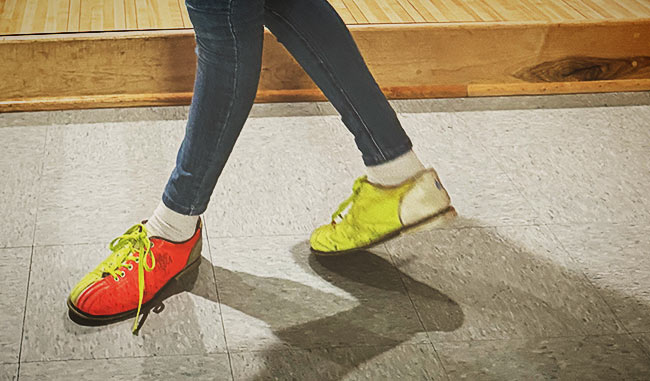
One of the peculiar aspects of bowling is the funny shoes they give you to wear. The shoes at the place we went to were half neon orange and half neon yellow. Mine even had a white velcro strap. Classy.
Now there are legitimate reasons they want us wearing their shoes, besides keeping the lanes clean and pristine (which I will now speak authoritatively about, after a quick Google search): First of all, the soles are super slick, which helps you slide, allowing you to achieve a smoother motion when bowling. If you’re sticking to the floor, you can injure your knee, ankle, or foot. Meanwhile, the rubber heel helps you stop sliding after you roll the ball, keeping you from falling.
Fine.
But must they also look like clown shoes?
It’s hard to be taken seriously after rolling a strike like a boss when you strut back to your seat looking like Bozo the Clown’s small-footed second cousin with a neon fetish.
Alas, after thinking about it longer than a sane person would, I wonder if it might be beneficial to always wear bowling shoes.
Every day. Even when we’re not bowling.
Maybe it would help us take ourselves less seriously.
After all, taking ourselves too seriously is one of the biggest symptoms of Adultitis. In our quest to be seen and valued, it’s tempting to put on airs to impress others. But that can lead us to ignore people who need our help (or alienate us from people who can help us). Or, due to our desire to be seen as competent or feel in control, we are prone to pity parties or temper tantrums when things don’t go the way we expected. All forms of pride.
We could all benefit from a regular dash of humility.
What if that’s why we’re all currently walking around in bowling shoes of a different sort? Maybe that’s what that receding hairline is for. Or your conspicuous birthmark. The missing limb. The bowed legs. The lisp. The scar. The cleft palate. The gap between those two front teeth.
Most people have something about their physical appearance they wish were different (some being more obvious than others, of course). What if we looked at these “imperfections” as bowling shoes? Something we may not have chosen for ourselves, but have to wear regardless. Maybe they keep us grounded, from sliding into pride, reminding us that we aren’t perfect while helping us to take ourselves less seriously.
Because even after rolling a perfect day, you’re still wearing those funny shoes.
Oh, and it can’t hurt to keep in mind that everyone else is wearing them, too.
🤔 I wonder…what are your metaphorical bowling shoes and how have they benefitted you in some way?
Have you ever made your own frozen custard with milk you got from your own cows?
Have you ever made cider from apples you picked from the orchard in your backyard?
Have you ever been so self-sustaining that you only need to go to the grocery store once a month?
Have you ever built your home from scratch with your own hands?
I haven’t.
But I have friends who do all this and more. They are not Amish, and they are not “preppers,” but the life they live is more reminiscent of Little House on the Prairie than Modern Family.
They fascinate me. And the more I hear about their life, the more my heart sings. And this confounds me. Because normally feelings like these lead to one of two things: Either a desire to have what they have or the realization that I have identified a kindred spirit. We are the same!
Except in this case, I don’t have cows. I have no interest in waking up at the butt crack of dawn every morning to milk them. We might plant a few fruit trees this year, but nothing resembling an orchard. I enjoy getting my groceries delivered every week. I am not capable of building a shed, let alone a whole house. (I swell with pride when I install a shelf.)
Although I respect the heck out of their life, I have no desire for it to be mine. And it doesn’t appear that we have anything in common because my life is nothing like theirs…
Oh wait, yes, it is.
There is one big thing we share: We are living life by our own rules. We are not abiding by the paint-by-numbers approach.
We have burned the paint-by-number to ashes.
Being a witness to a family that has such a blatant disregard for almost every single regular way of doing things is what makes my heart sing. That level of mindfulness—and disregard for the status quo—is rare.
I resonate with people who live life on their terms. Even if it looks completely different than mine. It energizes me, and it fires me up because it gives me a sense of what’s possible when someone is mindful of the life they want to have. It expands my own horizons of what I see as possible, and I can’t help but wonder how much better the world would be, how much happier, less depressed, and angry and lost people would be if more of us refused to settle for the “regular” way.
There is a regular way of doing everything. Having babies. Schooling your children. Making money. Finding a job. Taking vacations. Planning a wedding. Worshipping God. Learning. Teaching. Retiring.
Interestingly, the regular way is different in different cultures. And the regular way is often a perfectly fine way for most people in most situations.
Heck, you can get pretty far in life without having to make any real decisions on your own. The regular path is there for you, starting with how you should think about what you should do after high school, to what to have them read at your funeral.
The problem is that Adultitis sets in when we settle for the regular way more often than not.
Because we’re not all the same.
And the regular way is terrible as a one-size-fits-all solution.
If your soul feels stifled, if you feel the sad, heavy cloud of Adultitis reigning over you, maybe it’s because you’re settling in one or more areas of your life, having made choices that are perfectly fine for the majority of people…just not you.
Consider this a permission slip to skip the regular way and try a different road. You can always come back to the one you’re on later. (The well-trodden path is easy to find.)
Others have already made the decision you are considering but are hesitant to commit to. Find them. Borrow courage from them. Learn from them.
That’s why I love spending time with my cow-milking, custard-making friends. They remind me that a life far from regular is the best kind there is.
(And the cider is delicious, too.)
🤔 I wonder…who is someone you’re inspired by who skipped the regular way of doing something?
Your team is in bad shape. Here you are in the playoffs, and you’re losing. Even though you’re somehow only down by six points, nothing is going right. You were flying high earlier in the game, leading by two scores. Everything was clicking.
And then…
A turnover and two huge penalties gave your opponent some easy scores. None of the plays you’re calling are working. Your best running back got injured and is out for the game. Your players are growing more discouraged as each second melts off the clock. Now the other team has the ball and they’re driving down the field. If they score a touchdown—and your team is showing no sign of preventing it—this game is over.
Stay with me on this metaphor; we’re going somewhere. You might not be a football coach—or even care about football—but perhaps this sounds eerily similar to life right now.
Everything was going well. Finances were in good shape. Things at work were looking up. You and your spouse were on the same page. The kids were getting along.
And then…
Your spouse got sick and has been out of commission for over a week now. All of a sudden, your kids’ teachers decided to team up and go for the world record for most homework assignments. The dishes in the sink are a food-encrusted skyscraper. Your children are expertly pushing one another’s buttons, and tempers are flaring.
Adultitis is winning hard.
But let’s go back to our imaginary football game…
Your opponent is only twenty yards from the end zone. A field goal could ice the game; a touchdown will undoubtedly send your team home for the offseason.
And then…
Their quarterback drops back to pass. He’s got a receiver wide open at the goal line and lets the ball go. Out of nowhere, your safety cuts in front and intercepts the pass! He’s got ninety-five yards of open grass ahead of him…as he streaks down the sideline, the crowd erupts into delirium. You’re jumping up and down, and your arm is like a windmill, waving him toward the end zone. He crosses the goal line, scores a touchdown, and ties the game! The stadium is shaking as your players sprint on the field to celebrate.
You still need to kick the extra point to take the lead, but one thing is certain.
Momentum has shifted.
There’s not much more exciting for a team on the brink than a game-altering “pick six” like I just described. For the sportsball ambivalent, a “pick” is slang for “interception” and the “six” denotes how many points a team scores on a touchdown.
Wouldn’t it be nice to be able to summon one of those up in real life, when Adultitis has a stranglehold on you and your family?
Well, you can.
That’s exactly how we use “Pajama Runs” in our household. When Adultitis is having its way with us and everything seems to be going wrong, Kim and I pull out pots and wooden spoons and start banging on them. Our kids know the sound. The mood in the house immediately changes as everyone hurries to the car—even if they are in their pajamas—and we head out for ice cream.
We typically only do this a few times a year, but it always does the trick. Momentum shifts. Perspective is gained. Fun is had.
It’s like a pick six, and Adultitis loses big time. The only difference is that in football, you can’t call a play that will guarantee a pick six. It’s true: you actually have more power in real life.
Pajama Run is our go-to play, but you can draw up your own. It just has to be some kind of activity guaranteed to be fun that immediately and physically shifts you to a dramatically different place than your current environment. For maximum results, it should feel a little like a rule that doesn’t exist. (See: wearing pajamas in public and going out after bedtime, or having ice cream right before dinner, as we often do.)
When you’re in the middle of an Adultitis attack, it’s common to feel pretty helpless, and it’s tempting to throw in the towel. Don’t give up! You are the head coach of your life. You have the power to shift momentum.
The war will rage on your whole life, but you can win today’s game.
Now, blow that metaphorical whistle around your neck, call a timeout, and draw up a play that sends Adultitis to the showers.