
Author: Jason

  • How to Fix the Whole World

    The current state of the world is…not great.  

    So many of our problems are global, governmental, and systemic, stemming from conflicts spanning thousands of years. Perhaps, like me, you wonder, “What the heck can one person do?”

    When I am overwhelmed by an avalanche of things I can’t control, I find it helpful to focus on what I can. And then I came across this quote from St. Teresa of Calcutta:

    “If you want to bring happiness to the whole world, go home and love your family.”

    Ah, good ol’ Mother Teresa. What a pleasant thought from a sweet old lady beloved the world over. It’s a nice sentiment for a greeting card, but a naive prescription for solving what ails our world.

    Well, that’s how it seems, if you didn’t know what a tenacious, uncompromising spark plug she really was.

    Of course we love our family, we think. Check. Done. Got it. After patting ourselves on the back for acing a homework assignment from perhaps the greatest saint of the twentieth century, we think, ok, what else?

    Buckle up, buttercup. 

    We all say we love our family, but do our actions match our words?

    • Are you spending real time with your family, or are you spending money to make up for all the times you’re not there?
    • Is it quantity time, or just scraps of time here and there you call “quality” time?
      When you are together, how much time do you do what THEY want to do, on their terms?
    • How much time do you spend criticizing your spouse or trying to “change” them?
      Do you ever take on some of their household responsibilities to give them a break?
    • Do you take out the garbage before your wife has to remind you four times?
    • Do you ever give your husband back rubs, or are you too busy pointing out that he forgot to take out the garbage again?
    • How protective are you of family dinner time? How many times a week do you eat dinner together?
    • If you have children, do you allow them to struggle with hard things, or are you quick to swoop in to help them out of every jam?
    • Do they have chores they don’t get paid for?
    • How often do you put healthy limits on your kids, and how good are you at holding to them?
    • Are you paying attention to who your kids hang out with and what they’re watching?
    • How often are you labeled the “mean” parent?
    • How often do you sacrifice what you want for the good of your family?

    Oof. Suddenly, that sweet old lady’s Hallmark card just got real. I don’t know about you, but if I really want to follow Mother Teresa’s advice, I’ve got some work to do.

    Please know I’m not being accusatory here, only trying to provide a full picture of what true love looks like. Loving your family well is hard. It goes far beyond providing room and board, buying gifts, and shuttling them to and from myriad obligations.

    Heck, I expect that if you are a regular reader here, you probably can check off many of these things with confidence. That’s great! If so, let this serve as a reminder that you’re doing good.

    Because the world—and Adultitis—will bombard you with reasons you’re not.

    It will try to get you to place your attention on your career. Your income. The size of your home. All while convincing you to embrace the mantle of “providing a better life for your family.” It’s not bad to want a better life for your family, as long as it doesn’t come at the expense of loving them well. We do a lot of things “for our family” that, if we’re honest, are really more about making us look good.

    I got an email from a woman who had a great job at a bank. Then she gave birth to a daughter with health challenges. She made it work for a while, but eventually quit the bank and started an in-home daycare to be with her kids. It came with a pay cut and a plummet in status. Even though she took countless classes and became certified as an early childhood educator, she was often referred to as a “babysitter” by friends and peers. She admitted that she went down the negative road of “what ifs” from time to time. Now that she’s retired, she is grateful for the decision she made and the impact she was able to have in the lives of so many, including her daughter.

    Loving your family well isn’t easy. It’s hard and uncomfortable, often bringing feelings of doubt, uncertainty, and fear.

    It’s true that you may not be able to make a dent in the policy of global governments.

    But it’s also true that no one on Earth can fulfill your mission to love your family.

    I suppose it takes a fool to believe that loving your family really can bring happiness to the whole world.

    But it would be more foolish not to try.


    🤔 I wonder…what hard thing would you add to the list of ways to love your family well?

  • When to Be a Houseplant

    Sometimes you just need to be a houseplant.

    This statement was shared by Shannon, a friend who had finally emerged from a hard season filled with challenging health issues. They often left her feeling depleted, without the energy to do much of anything.

    And so she gave herself permission to be a houseplant.

    I laughed at the metaphor, calling to mind the times I’ve sunk deep into the couch and slipped into a vegetative state.

    But she went on to note that although houseplants are stationary and require help from others to stay alive, they aren’t doing nothing. They are very much alive, producing oxygen for us to breathe while providing joy, peace, and beauty to others.

    That’s certainly not nothing.

    It’s a good reminder for all of us, especially in a culture that fetishizes busyness, action, and so-called productivity. Sometimes productivity isn’t flashy.

    Or even visible.

    In agriculture, a field needs to lie fallow every seven years, or it will not maintain its fruitfulness. But that fallow period is not nothing. Even while resting, the field has activity and growth, giving the land time to bring forth new fertility. During that period where the field seems to be doing nothing, it is vitally productive.

    I have learned as a creative person that I have to let my life go fallow sometimes, too, especially after a period of intense activity. While my life is slowed down, my body can rest, my spirit can heal, and my mind can become a more fertile place for new ideas to take root.

    A good way to look at it is the way James Taylor looked at creating his first album after twelve years of touring. After explaining that he needed time and space to compose new music because he’d been so busy on the road, a reporter asked, “So you took time off to write?” James replied, “I didn’t take time off work; I did a different kind of work.”

    Whether our creative juices are depleted or we’re exhausted from a hard season of life, sometimes in life we need to do a different type of work.

    Sometimes the best course of action is to stop pushing and stay still. Rest. Breathe. Look for small ways to bring joy, peace, and comfort to others.

    Sometimes you just need to be a houseplant.


    🤔 I wonder…have you ever been forced (or given yourself permission) to “be a houseplant?” What did that look like?

  • All Masterpieces Begin with Chunky Crayons

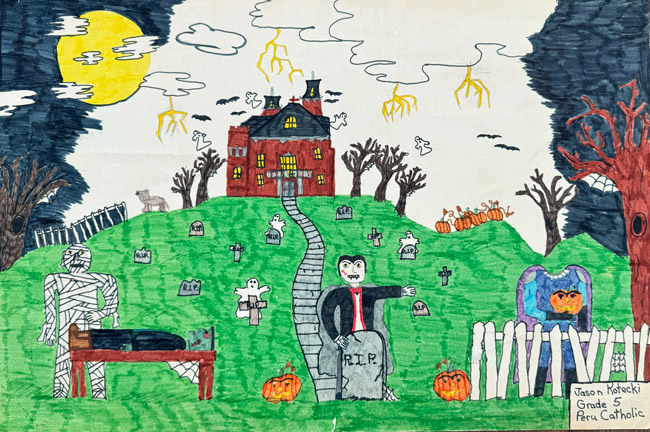
    This won me first prize in a city-wide Halloween poster contest when I was in 5th grade. I’ve come a long way.

    Imagine a young child proudly showing you a drawing she made. Using a handful of stubby crayons, you can make out what appear to be some trees, although they look more like wobbly circles sitting on top of crooked brown rectangles. There are some figures in the scene, too, but it’s hard to tell exactly who they are supposed to be.

    Now imagine yourself rolling your eyes as you criticize the drawing, pointing out the clichéd subject matter, the sloppy scribbles, and the unrealistic use of color. You matter-of-factly declare that it’s just terrible—probably the worst drawing you’ve ever seen—and boast that you could easily draw something so much better.

    The little one says nothing, but a single tear rolls down her cheek as she turns away, dejected.

    Who knew you could be such a jerk?

    Oh, but you are.

    Every time you criticize something your past self made.

    I was watching an interview with Jerry Seinfeld, who was promoting the release of his book, Is This Anything? It’s an exhaustive collection of all of his comedy bits from his illustrious career, including his earliest stuff from the seventies. The interviewer asked him if he ever looks back on his old stuff and thinks about how he could make it so much better now.

    “Yes,” said Seinfeld. “But anybody can look at their early work and go, oh my gosh, this is not as good as I got later on. And I started doing that, but then I thought, that’s not really fair to your young self. Because that stuff—whatever it is—got you to the next step, which got to the next step, and the next step. So I thought I’m going to be nicer to this early stuff, instead of going, this is so basic, so infantile, so hacky.”

    I can relate to this. A few of my childhood drawings still exist, and of course, they are very rudimentary. (See the example above.) But I even turn up my nose at most of my high school and college work—which is much better than my fifth-grade drawings—immediately noticing every flaw and rolling my eyes at the obvious mistakes.

    I can be a real a-hole to my younger self, who was doing the best he could at the time, and whose effort helped lay the groundwork for where I am now.

    I say things to myself I’d never utter to another human being, let alone a small child.

    Perhaps you do the same with your earlier creations, whether they’re drawings or songs or photos or quilts or woodworking projects or lesson plans. Indeed, the same is true of the greatest thing you and I are in the process of creating: our very lives. We all have a few decisions we made when we were younger that we wish we had made differently. Choices that, in retrospect, seem like nothing more than a waste of time or money.

    It’s probably the reason we are so hesitant to start new things now, as adults: We are all too aware of the a-hole inner critic peering over our shoulders.

    But just like the child with a few chunky crayons, we did the best we could with the skills, experience, and information we had at the time.

    We need to be kinder to our younger self.

    Do not despise these small beginnings from your past.

    When you see your old stuff, instead of criticizing the flaws, revel in how far you’ve come, and applaud the effort and bravery it took to begin. 

  • What You and Norman Rockwell Have in Common

    I used to think art was art, and even though everyone had a different style, artists were all on the same team. It took art school to re-educate me.

    I discovered there were two main groups. One was the fine artists. The other group consisted of illustrators and graphic designers, of which I was a part. We were seen as second-class citizens, sellouts willing to take money to create whatever someone else wanted us to make. Many of the fine artists saw themselves as more artistically pure because they were creating art for art’s sake, achieving self-fulfillment, and bringing about social change. They, too, sold their work, but often to lesser success.

    One of my painting teachers had a not-so-veiled disdain for the illustrators in his class. (Or maybe just me.) He had a particular distaste for Norman Rockwell, who has always been one of my favorites. In his time, Rockwell was one of the most well-known and financially successful artists, but alas, was firmly in the camp of illustrator, and therefore a money-grubbing capitalist in the eyes of my teacher, who also criticized Rockwell’s saccharine subject matter.

    Norman Rockwell was known for painting scenes of idealized Americana, which the public adored. Only recently did I learn that Rockwell himself was well aware of this criticism. Far from being naive, he acknowledged his paintings were sentimental and idealized. He knew the world wasn’t perfect; he simply painted it as he wished it to be.

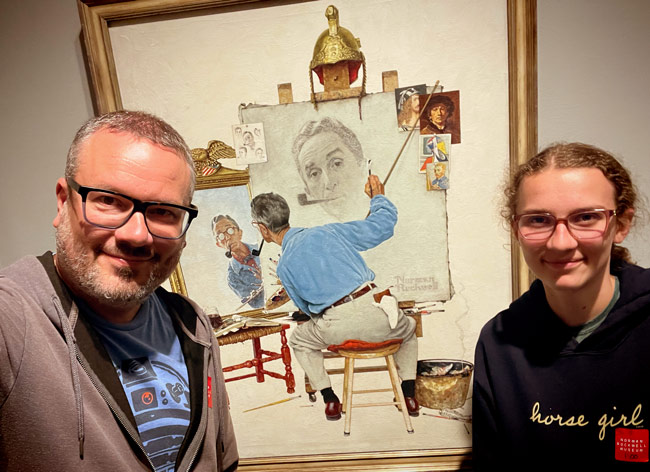
    In his later years, as the civil rights movement was picking up steam, Rockwell did a series of paintings on race relations. I had a chance to see some of them up close at the Norman Rockwell Museum in Stockbridge, Massachusetts. They are a bit of a departure in theme but retain his trademark style and knack for engaging storytelling. (This is my favorite.) President Obama hung “The Problem We All Live With” in the White House, which depicts six-year-old Ruby Bridges entering the all-white William Frantz Elementary School, escorted by four US marshals.

    I also learned that Norman Rockwell succeeded where President Franklin D. Roosevelt could not. FDR gave a speech about the Four Freedoms in order to gain support for the war effort. They were powerful ideas, but didn’t capture the imagination of the American people until Rockwell turned them into emotional paintings that helped raise tons of money for war bonds.

    I can’t help but wonder if Norman Rockwell had a bigger impact on America than any other artist working at the time, “fine art” or otherwise, simply because he had the trust of so many millions of Americans. In the days long before social media, he was one of the few artists who was truly known and had a following of millions of middle-class Americans, the backbone of the country. Perhaps that following, and the goodwill he had built with them, allowed him to lead them in some new ways of thinking.

    Not bad for a lowly illustrator.

    So what lessons are here for us?

    First of all, I admire that Rockwell painted the world the way he wanted it to be. A better world always starts with a vision. Just as John F. Kennedy—a contemporary of Rockwell’s who was the subject of his final Saturday Evening Post cover—cast a vision of the moon landing before there was any realistic proof that we could do it, Rockwell offered up a positive aspiration of what could be. His paintings may not have reflected reality per se, but they served as a light to guide his viewers to an ideal to strive for.

    We live in a world with lots of problems. Showing the world an example of how to make it better, through your actions, words, or work, is always an admirable pursuit.

    Secondly, Norman Rockwell was very talented. So are you. You will encounter no small number of people in your life who are happy to tell you that you’re doing something wrong. They’ll criticize your reason for making art or how you make it. The way you approach your career. Market your services. Decorate your home. Dress. Vacation. Parent. Teach. Worship. They will give you a million reasons why being you isn’t good enough.

    Be you anyway.

    Your way of doing things might be just what the world’s been waiting for.


    🤔 I wonder…what’s something people have criticized about you that seems to be working out pretty well?

  • 5 Favorite Words of Adultitis

    I recently did a presentation on innovation. In preparation, I asked attendees to rate themselves on a scale of 1 to 10 on how creative or innovative they considered themselves. Then, for those who didn’t rate themselves a 10 (there was only one who did), I asked them what obstacle was in their way.

    A number of people judged themselves to be too practical or admitted to getting hung up on analyzing the practicality of an idea.

    Ah, practicality: The enemy of awesome ideas.

    Many a brainstorming session has come to a screeching halt when someone suggests an idea deemed “impractical.” Progress dies as a debate emerges around whether or not an idea is practical, logical, feasible, sensible, or affordable. No more ideas are generated, and everyone leaves the meeting thinking it was a giant waste of time.

    Meanwhile, Adultitis takes a victory lap.

    Because practical, logical, feasible, sensible, and affordable are five of Adultitis’s favorite words.

    Have you ever met a five-year-old with a big idea concerned with it being practical, logical, feasible, sensible, or affordable?

    Imagine a meeting in which the stakeholders of a restaurant were trying to figure out the best way to stand out in a competitive tourist market. It’s a Swedish restaurant, and the meatballs and pancakes are already top-notch. Now imagine someone raising their hand and saying, “I have an idea…why don’t we plant some grass on the roof and throw some goats up there?” 

    Crickets. 🦗

    Except that’s exactly what Al Johnson’s in Door County, Wisconsin did. It’s quite the sight when you see the bright green roof driving down the street. People regularly gather on the sidewalk to gawk and take pictures of the goats (even though there are probably fenced-in goat paddocks less than a mile away, sans the tourists). It’s one of the top three things people share with others after their Door County vacation. And the place is always packed.

    But I’m certain it didn’t come about via a staff-wide brainstorming session on a Monday morning. Because it never would have passed muster as practical, logical, feasible, sensible, or affordable.

    The best ideas rarely are…at first.

    Why bother building a horseless carriage that runs on gasoline when there is nowhere to drive it and no such thing as gas stations?

    What idiot would suggest color as a way to sell more computers, when it has absolutely no impact on more important qualities like speed, power, storage capacity, or price?

    Or consider the feedback a Yale University professor gave to Fred Smith on a paper he wrote proposing a reliable overnight delivery service: “The concept is interesting and well-formed, but to earn better than a ‘C,’ the idea must be feasible.” 

    Hmm, there’s one of Adultitis’s favorite words again: Feasible.

    Unfeasibly, Fred Smith went on to found Federal Express.

    Here’s an interesting point: The professor was right. In order for FedEx to succeed as an actual business, it did have to be feasible. The professor just didn’t have the capacity to see how it could be. Fred did and eventually figured out a way to make it so.

    Steve Jobs used color to make the original iMac computers look like fun, candy-coated objects of desire, and their great success turned the tide from Apple as a failing brand to a global behemoth.

    Time and time again, success comes to those who embrace counter-intuitive ideas, exploit the blind spots of experts, and break rules that don’t exist. When the crazy idea works, it suddenly looks like a foregone conclusion in hindsight.

    I assure you that grass and goats didn’t seem like an obvious move at the time.

    And that first horseless carriage, later known as a car, wasn’t anything close to practical, logical, feasible, sensible, or affordable…at first.

    These qualities are important, eventually. Practicality and logic are superpowers. But they should not be dictators. Please don’t let them kill your ideas before they’ve had a chance to get off the ground.

    And maybe even onto the roof. 🐐

  • How to Go Undefeated in Everything

    I guess I need to get used to having wisdom bombs dropped on me by my son because they keep happening.

    Especially through the game of baseball.

    The first came a few years ago when I was putting the kids to bed. I always ask for their favorite part of the day. Ben’s was watching the Cubs game with me. It blew me away because I would have listed it as my lowlight. They lost a game in excruciating fashion, effectively ruining my day. Interestingly, I no longer remember if they blew the lead or came up short in a comeback — or even who they played — but I remember the lesson he taught me. All he cared about was spending time with me, regardless of the outcome.

    As I’ve shared before, I have some past trauma from a few adults who made me feel “less than” for being a Cubs fan. I’m not talking good-natured teasing, but more in the vein of a “you’re a dumb pathetic loser for liking them” vibe. I can see the absurdity in it all now, but when a grown-up makes you feel like that when you’re a certain age, it’s hard to not have a little of your self-identity wrapped up in it as you get older.

    All this to say I used to take it pretty hard when the Cubs lost, until Ben gave me back the joy of watching baseball.

    Ben likes the Cubs because I like the Cubs. And this year, he has gotten into the stats and the players, and the announcers more than ever. This is the year he became a fan.

    But he doesn’t take the losses so hard. He’s disappointed for about three seconds and then moves on.

    Seeing Ben’s reaction has changed me. I respect his perspective and purity so much that I don’t want to inadvertently poison him with my own baggage, as those adults from my past did to me. So when we’re watching a game together, I keep my negative emotions in check, and his carefree attitude encourages me to brush off the losses. (We do still cheer and celebrate like crazy people when exciting things happen.)

    Because of this, years from now, I will think back fondly to the days of watching Cubs games with Ben on the deck under the umbrella, snacking on cherries, jeering at umpires, and cheering home runs with unbridled joy. I won’t remember the specific outcomes, because the wins and losses will have faded into unimportant footnotes in a treasury of wonderful memories.

    He continues to remind me that the outcome is not an all-or-nothing referendum on my self-esteem and worth as a human being. He’s helped me to appreciate what really matters.

    The other day, he dropped another wisdom bomb on me.

    The Cubs lost a game to the Mets they should have won that had a big impact on the standings. Ben casually remarked, “You have to look for the win in every game,” and then noted how good it was that their slugger broke out of a long slump with a single, triple, and home run in the losing effort. He declared that a win because they’d need him to perform well down the stretch if they wanted to win the division.

    “You have to look for the win in every game.”

    I don’t know where the hell he got that, but it wasn’t from me.

    The hidden bonus of this gem is that if you can find the win in every game, you never truly lose.

    And of course, this is way bigger than baseball.

    Not everything we attempt succeeds. Sometimes we don’t get the job, the role, or the girl. We don’t always get into the school we wanted, make it to the gate on time, or receive the diagnosis we were hoping for.

    But we can look for the win in every game.

    If you can find some useful knowledge that was gained, a hidden blessing in disguise, or something tiny to celebrate in every scenario you find yourself in, you never truly lose.

    This is how you go undefeated in life.

    Look for the win in every game.
  • Is Your Job Getting More Emotionally Expensive?

    “Inflation is real. And I’m broke.”

    This was shared with me by a woman in an organization for which I was preparing to speak. Although many people have struggled to keep up with the rising cost of goods, she wasn’t referring to money.

    Over the past few years, some of the most important jobs in our society have grown more emotionally expensive, thanks to the pandemic and other factors. They are harder to do and fewer people are willing to do them, yet we need them more than ever.

    Let’s consider nurses as one example. They are carrying unsustainable patient loads and burning out in the process. If one quits to save herself, what happens to the ones left behind

    But is she expected to sacrifice her own health, sanity, and relationships for the sake of everyone else? And exactly how useful is a burned-out, mistake-prone nurse with compassion fatigue?

    You could replace “nurse” with “teacher” or “social worker” or “airline pilot” or “police officer,” and on and on…

    Inflation is real.

    And with emotional costs rising, many people are finding themselves broke.

    So what do we do?

    Well, it depends.

    Self-help gurus promise easy answers because they are easy to sell. Unfortunately, complicated scenarios rarely have simple solutions. Each industry—each individual—has its own unique factors and challenges.

    A problem like this requires thoughtfulness and self-awareness. I must fight the temptation to boil it down to a one-size-fits-all answer that saves the day in one fell swoop. Instead, let me share some truths that may shed light on what makes sense for your situation.

    Truth #1: Life is hard. And that is normal. 
    We are consistently lured into pursuing a life of ease and comfort, conditioned to believe that something’s wrong if we experience anything otherwise. We humans put too much stock in what’s happening right this moment, falsely assuming the good times will always roll or this hard stretch will last forever. This is called recency bias. But it’s always been true that to everything there is a season. It could be that you are in a season of challenge that is extremely difficult, but also temporary. If so, take courage! Persist! Facing down difficulties will make you better, stronger, and, believe it or not, happier in the long run.

    Truth #2: It’s not your job to save the world.
    This is a hard one to swallow, especially if you’re like me and suffer from a bit of a savior complex. First of all, it feels good to help others. And wanting to help as many people as possible provides a sense of purpose, which is also good. Things go sideways if we develop an outsized expectation of the role we’re called to play. Yes, there may be few people who can do what you do as well as you can, but the fact is, you could get hit by a bus tomorrow, and believe it or not, the world will find a way to go on. (Why always a bus? Why not a VW Beetle packed with clowns? Or a DoorDash driver on a unicycle? But I digress.) Perhaps you just need to shift your perspective, take yourself a little less seriously, and give yourself permission to do the best you can and the grace to acknowledge it’ll never be enough. Why? Because it’s not your job to save the world.

    Truth #3: It’s hard to help people when you’re dead.
    Speaking of getting hit by a VW Beetle packed with clowns, bad things happen when you push yourself to the brink. You need time to rest and fill your cup. If you keep your foot on the gas, eventually your body will hit the brakes for you. To restate the obvious, it’s awfully hard to help others when you’re laid up in a hospital bed, or, you know, dead.

    Truth #4: It’s not all or nothing.
    When we feel overwhelmed and depleted, we commonly default to extremes. Your options are not limited to “quit this job immediately” or “stick with it forever until it kills me.” You could also give it another month, pray, re-evaluate things, and then decide to quit, stay, or…give it another month. You don’t have to resign yourself to your current situation, either. Maybe you can go half time. Maybe you can transfer to a different department. Maybe you just need a little vacation. (Or a long one!) Perhaps your priority should be to give yourself a little space to identify all your options because there are probably more than you realize.

    So…if you find yourself having a hard time keeping up with the rising emotional costs of your particular situation, what should you do?

    I don’t know.

    But I expect that you might, especially if you felt one or two of these truths ping your soul.

    Thank you for caring. Thank you for your hard work. Thank you for making a difference.

    I wish you clarity and peace of mind as you discern what’s next.

    And the agility to avoid any clown-stuffed vehicles that cross your path.

  • What Are the Chances?

    The baseball deflected off the bat, soaring high and out of play. It reached the roof over the grandstand above us, but I suspected it might roll back. It did. I watched as gravity reversed the ball’s course, and it fell back into the crowd. Hitting the aisle about twenty feet away, it ricocheted wildly off the concrete and raced through a forest of arms, right toward me. I kept my eye on the ball and relied on the instincts and reflexes honed in my days as a second baseman. I alertly shifted my hands to my left, and the ball stuck.

    I had just caught a foul ball at Wrigley Field on Father’s Day weekend.

    Still in shock as I handed the ball to my son (but acting like it was no big deal), I wondered, What are the chances?

    There were about 37,000 fans in attendance. According to foulballz.com, roughly 46 foul balls are hit per game. Assuming 25 actually made it into the crowd, I had a 1 in 1,500 chance of catching a foul ball that day. The weird physics in play that conspired on my behalf make it feel even more unlikely.

    To top it all off, the Cubs won after hitting 3 home runs in one inning and scoring six runs in another. We got to sing “Go Cubs Go” with the Wrigley Field faithful.

    What a difference a year makes.

    You see, exactly one year earlier — to the day — a kind neighbor was helping me clear trees from our driveway with a chainsaw so that I could make it to the airport for a speaking engagement. A 112-mile-per-hour straight-line wind had descended upon Sheboygan the night before, ripping 150 trees out of the ground in a matter of seconds, leaving a splintered mess in its wake.

    What are the chances?

    For weeks on end, we lived with the constant reminder of the trauma, as our backyard was a jagged landscape of splintered trees and shredded memories. 

    We had to hire professional lumberjacks to take them all away, leaving behind an uneven patch of land, a bumpy scar reminding us of all that was lost.

    Eventually, fifty-seven dump trucks of dirt were brought in, and the land was leveled. Grass seed was sown, but for a long time, it lay barren and lifeless.

    Progress was being made, but it was happening so slowly that it seemed like life would never return. The financial aftermath still hangs heavy over our household.

    But exactly one year later, not only did I experience the highlight of catching a foul ball at a Cubs game, but I sat at the edge of our bluff, overlooking the grandeur of Lake Michigan. 

    With my bare feet in luscious green grass.

    It’s a reminder to me of the baffling duality of time. It goes from dragging on mercilessly to passing by in the blink of an eye.

    We went from “Will this fresh hell ever end?” to “Wow, that happened a year ago?” 

    When things are going badly, it feels like time stands still and the odds of a turnaround seem impossibly low. Yes, good times are fleeting, but so are the bad. 

    As the young girl reminded Eric Draven in The Crow, a favorite movie of mine, “It can’t rain all the time.

    Blessings can appear out of nowhere when we least expect them. If you’re in one of those “will this ever end?” periods right now and you need to know the odds of a turnaround, take heart.

    The chances are very good that something amazing is about to happen.


    🤔 I wonder…what is the most amazing, unlikely thing that happened to you in the last year?

  • A Moonrise to Remember

    Our first official Moonrise Movie Night! Can you spot the “red” moon peeking out from the horizon?

    I pulled out a notebook and pushed aside the bowl of creamers and the container of jellies.

    My family was at one of our favorite breakfast spots, our go-to place for celebrating big milestones. This day was decidedly less joyful, however, more of an escape from a nightmare we recently experienced.

    A few miles away, our house was an island in an apocalyptic landscape. A week before, a hurricane-force straight-line wind mutilated an idyllic stand of 150 pine trees into an ugly riot of splintered, uprooted sticks, violently strewn about.

    Amidst the aftermath, it was hard to imagine anything good coming from it. But Kim and I have adamantly taught our kids to ask an important question anytime a storm sweeps through our lives: What does this make possible?

    I took a sip of coffee. With all the faith I could muster, I reminded my kids that God was working even then, and He was going to turn the mess into something magical. Opening to a blank page in the journal, I declared that it was time for our family to dream again.

    What new possibilities did this sudden and unexpected clearing make possible for our backyard?

    Slowly, ideas bubbled up. It started with a list of fruit trees and visions of the delicious bounty they’d someday provide. Maybe a strawberry patch. Some raspberry bushes. Someone suggested a vegetable garden. Then a BB gun range made the list.

    I don’t know who said it, but eventually, we added “movie nights.” 

    A vision grew of this new open space being occupied by a group of friends gathered to watch a movie on a huge screen overlooking the lake, with the moon rising from the horizon. Dubbed “Moonrise Movie Nights,” it became a dream that sustained us for the many months it took to clear the trees, receive fifty-five dump trucks worth of dirt onto our property, and wait for the grass seed that was planted to transform from something reminiscent of a teenage boy’s chin into something that looked like a real lawn.

    Weeks of research on the best options for a screen, projector, and sound system led to our first trial run as a family. That necessitated adding a few more cords and cables to the setup. Along the way, we picked up a retro red cooler for drinks and an old-timey popcorn machine on a cart.

    On the eve of Independence Day, a year and two weeks after the storm, we held our first official Moonrise Movie Night. I was giving an informal tour of my studio to the group of friends who had joined us. Recounting the history behind one of my paintings led to the recollection of the evening’s origin story. I got a lump in my throat realizing how far we’d come.

    As the darkness fell, we gathered around the screen on blankets and lawn chairs, with popcorn and bomb pops, to watch The Muppets. The weather was perfect. Halfway through the movie, the moon made her dramatic appearance. Bold and red at first, like the sun, then slowly glowing white as she ascended, tossing diamonds onto the calm lake below.

    It was a fitting culmination of a dream come true.

    I share this story in case you need hope. It could be that a storm has swept through your life recently. Believe me, I know that right now, it might look more like a mess than anything resembling magic.

    But perhaps the stage is set for something new to rise up.

    My experience has shown me time and time again that God loves bringing forth streams from the desert and turning storms into something stunning.

    Have faith. Now might be the time to turn the page and start dreaming big.

  • The Two Zoo Truths

    I have an odd experiment I’d love to try someday.

    I thought of it during a family visit to the Lincoln Park Zoo in Chicago, after going through several exhibits in a row in which the animals were either hidden or off exhibit. (It’s hard to tell if the jaguar is sleeping in a corner out of view or at the vet for a check-up.) After a few minutes of fruitless searching, we just shrugged our shoulders and headed to the next one.

    So I thought it would be interesting to remove all the animals from every exhibit at a particular zoo. How long would it take for the average visitor to realize that the zoo was empty? Pretty long, is my guess. And I suspect that if you allowed a few birds to fly around freely, you’d trick people into going longer before realizing there was not one animal on display.

    My family loves zoos, and we’ve been to a lot of them. (We even went to a few on a book tour!) I have discovered that there are two Zoo Truths you can count on:

    Truth #1: At least one of the animals you were looking forward to seeing will be off-exhibit or out of view. A bust. Of course, animals are animals. They are unpredictable. They can’t be made to always be “on.” The question is, will you let your disappointment ruin your day?

    Truth #2: There will also be at least one animal you’ll get an unexpectedly great experience with. Maybe one you never noticed before, or an up-close encounter with an animal you’ve previously overlooked. If you’re not too busy sulking after Truth #1 materializes, I guarantee you something magical will happen. 

    As I said, my family has been to a lot of zoos and has found these two Zoo Truths to be remarkably consistent. At the Lincoln Park Zoo, the giraffes were a bust and the red panda was MIA. (Maybe she was on a sabbatical?) But we saw snow leopards super close, and the young gorillas goofing off were an absolute hoot. Because we are well aware of the Truths, the disappointments were taken in stride, and we were able to savor the magic that was served up to us.

    Why don’t we have the same perspective on life? 

    Like animals, life is unpredictable. It doesn’t always go as planned. Why are we so surprised when things go sideways? 

    Sometimes we become overly invested in having things go a certain way, and we get derailed when they don’t. Maybe you thought you’d have found Mr. Right by now. Maybe you expected your career path to be a little less wonky. Maybe your big dream is taking its sweet old time.

    The thing we were hoping for might just be temporarily hidden. It might even be off the table for good.

    Not every dream comes true.

    That’s Truth #1. But don’t forget about Truth #2.

    If we limit the time we spend sulking, and we keep our heads up and our eyes open, we might notice something we didn’t expect. Something wonderful and magical and equally awesome. (Or dare I say…better?)

    Alas, none of this is possible unless we practice non-attachment from outcomes and open ourselves to surprises that come out of uncertainty. Kids are natural at this because they don’t have enough life perspective to know what to expect. Everything is new, so they more often experience surprise and delight than adults. 

    We can experience it, too; we just need to be more mindful about it. 

    I’ve found, at zoos and in life, that reminding myself that some things won’t turn out as I’d hoped, but there will be other cool surprises I never could’ve predicted, serves as a powerful reframe that makes a big difference.

    You might miss the giraffe you came to see, but maybe the baby gorilla will be worth the price of admission.